About Brycon costaricensis Angulo & Gracian-Negrete, 2013
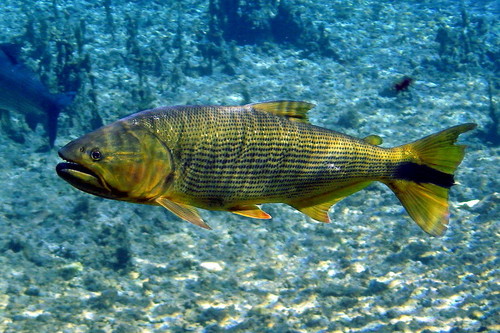
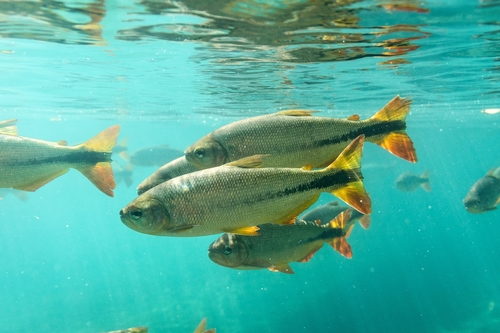
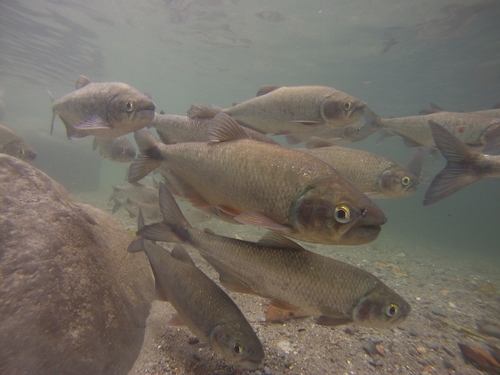
Brycon costaricensis can be distinguished from other Mesoamerican species of its genus by several traits. It has between 49 and 54 scales along its lateral line: this is more scales than B. argenteus has, and fewer than any other congener in the region. Its anal fin is clearly longer than the head, while the anal fin of other related species is roughly equal in length to the head. When compared to B. guatemalensis, this species differs in scale row count and also has an elongated, shallow caudal peduncle. The overall body color of B. costaricensis is silvery, with blackish edges on some scales that form vertical streaks. Its back is dark olive, and its belly is white. The rear margin of its operculum is black. Pectoral and pelvic fins are transparent; they are light pink or reddish in juveniles, and rosy gray or dark in adults. Dorsal and adipose fins are light pink, yellowish or reddish in juveniles, and rosy gray or dark in adults. A variably distinct blackish spot is present on the caudal peduncle. The caudal fin is pale pink, yellowish, or reddish, especially in juveniles, and dark in most adults. The anal and caudal fins typically have dark edges. This species reaches a maximum total length of 59 cm, or 23 inches. Brycon costaricensis is native to southern Central America, where it occurs along the Atlantic slope of Nicaragua and Costa Rica. Its range stretches from the Wawa River system in northern Nicaragua to the Matina River in southern Costa Rica. It has been recorded from the Prinzapolka, Escondido, Sabagol, San Carlos, Sarapiqui, Tortuguero, Pacuare, and Matina rivers, and also lives in rivers that drain into Lake Nicaragua. It can be found in lakes, rivers, and creeks with flow rates ranging from slow to high.