About Brunia noduliflora Goldblatt & J.C.Manning
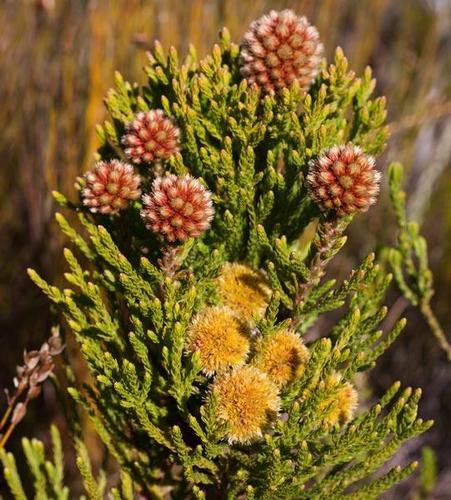
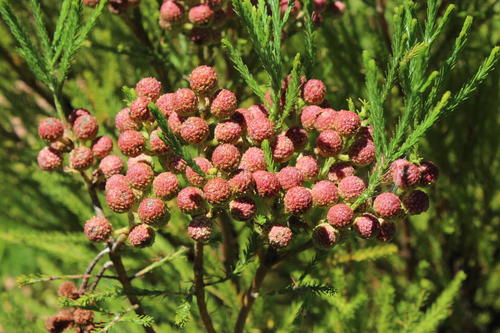
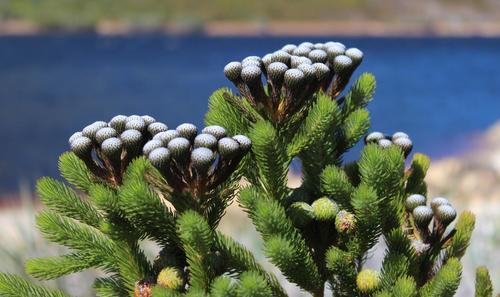
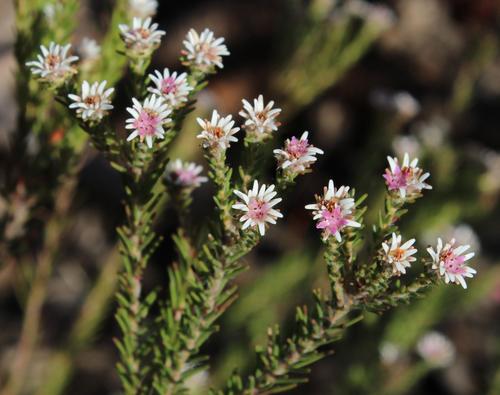
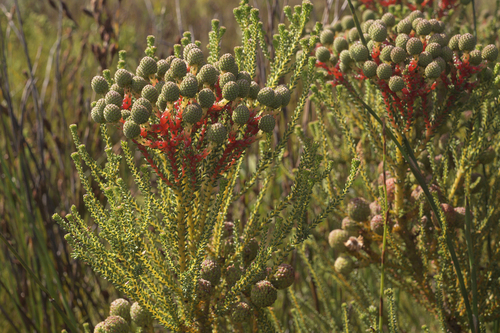
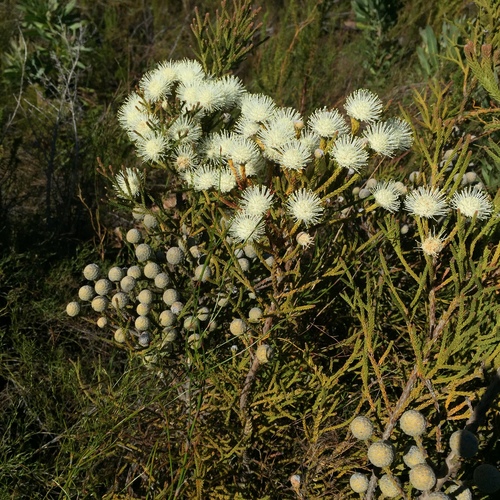
Brunia noduliflora Goldblatt & J.C.Manning grows multiple stems from a woody rootstock. It has stalkless, ericoid leaves that overlap like triangular or lance-shaped scales. Its spherical, cream-colored inflorescences bear long stamens, which give the flower clusters a fluffy appearance. The flowers themselves are short-lived, but their round grey-brown seedheads persist much longer. This species is endemic to the southern and southwestern Cape of Africa. It is common across a range extending from the Olifants River Mountains to Piketberg, the Cape Peninsula, Jonkershoek, the Hottentots Holland Mountains, and the Kogelberg, continuing through to Hermanus and Elim. It can also be found in the areas around the Van Stadens Mountains and Uitenhage. This shrub grows at low to high altitudes, on hills and rocky sandstone slopes. It is a fire-adapted endemic plant of fynbos grassland, a habitat where periodic fires are common, and uses two strategies to survive fires: reseeding and resprouting. Its underground woody rootstock, called a lignotuber, resprouts the following autumn after a fire, while seeds held in the seedheads are released and dispersed after fire. Brunia noduliflora is sometimes used in floral arrangements for its unusual seedheads and long-lasting foliage. It is sold commercially under the trade name "Spray Brunia".