About Brunfelsia pauciflora (Cham. & Schltdl.) Benth.
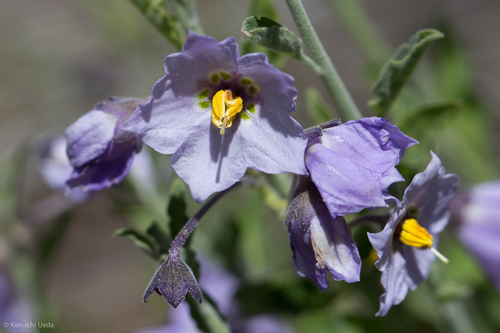
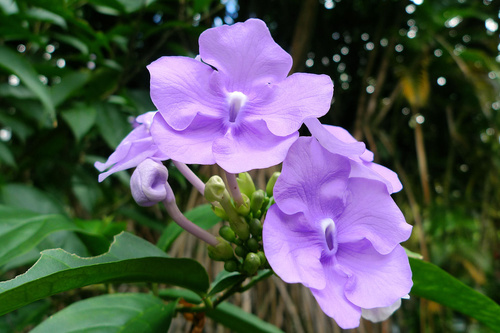
Brunfelsia pauciflora (Cham. & Schltdl.) Benth. is a shrub that grows up to 2.4 meters tall and 1.5 meters wide. Its bark is greyish-brown, mostly smooth, and only occasionally marked by longitudinal cracks. Sparse branches grow upright or spreading; these dark green, smooth branches are sturdy and glabrous, rarely covered in fluffy hairs or glandular trichomes. Its leathery leaves can reach up to 16 centimeters long, dark green on the upper surface and paler on the undersides. Leaves grow either distributed along branches or clustered at branch tips. Hairless petioles measure 5 to 12 millimeters in length. The leaf blade is firmly membranous to nearly leathery, 6.5 to 16 centimeters long and 2 to 6.5 centimeters wide, elongated to elongate-lanceolate, and rarely elliptic-oblong to ovate-elongated. Leaf tips are pointed to short-pointed, and rarely blunted or notched. The leaf blade base is wedge-shaped to tapered. The leaf surface is glabrous, or dotted along the underside of the midrib, or slightly glandular hairy. The upper leaf surface is dark green, dull to shiny, while the underside is light green. Five to eleven side veins branch from the midrib, running straight or in a wide arc. Four stamens are positioned in the upper part of the floral tube; the white stamens are almost circular, somewhat trough-shaped toward the anther. The upper pair of stamens is 4 to 6 millimeters long, while lower stamens are 2 to 4 millimeters long. Greenish-brown anthers are 1.5 to 2 millimeters long, and circular to kidney-shaped. The bright green ovary is 2 to 3 millimeters high, 1.5 millimeters in diameter, and shaped conical-ovate. The thread-like style is 25 to 30 millimeters long and colored lavender. The stigma is bilobed, white, 1 millimeter long, with slightly differently sized stigma lobes. This species occurs mainly on the Atlantic-facing slopes of the Serra do Mar in southeastern Brazil, ranging from the state of Rio de Janeiro to Santa Catarina, from sea level up to 1500 meters in altitude. Most individuals grow in pluvial rainforests with annual rainfall up to 1600 mm. Plants of this species are found on shady river banks, ravines, and in forests growing in damp, well-draining soils. According to a 2012 compendium published by the European Food Safety Authority, the roots of several species in the genus Brunfelsia contain compounds that can cause human health problems if consumed. These compounds include indole alkaloids derived from beta-carboline: harmine, tetrahydroharmine, harmaline, manacin, manacein, and dimethyltryptamine, as well as amidine derivatives such as pyrrole 3-carboxamidine.