About Bruguiera gymnorhiza (L.) Lam.
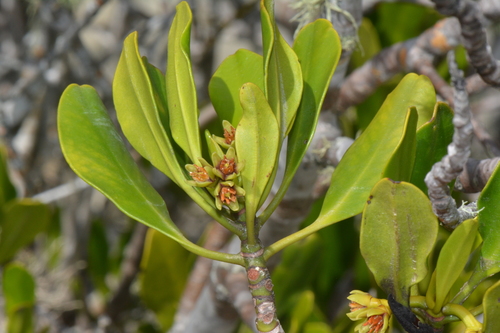
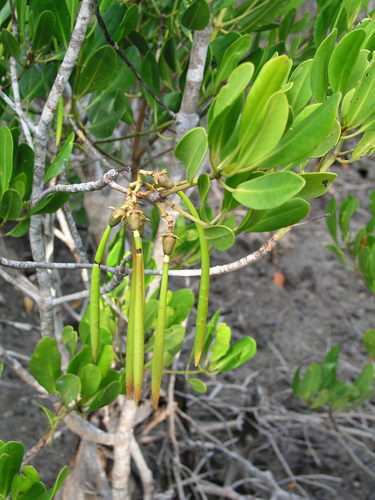
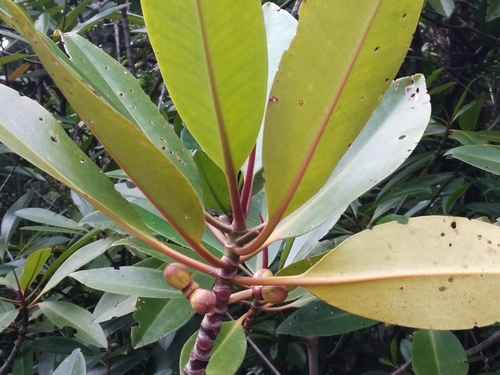
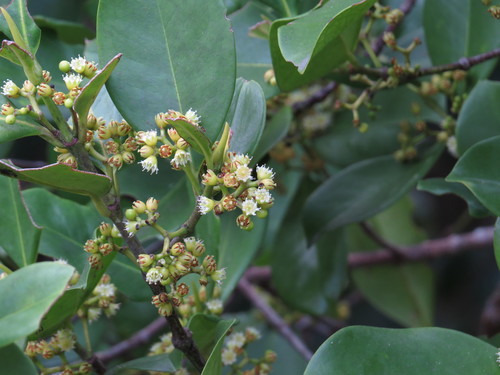
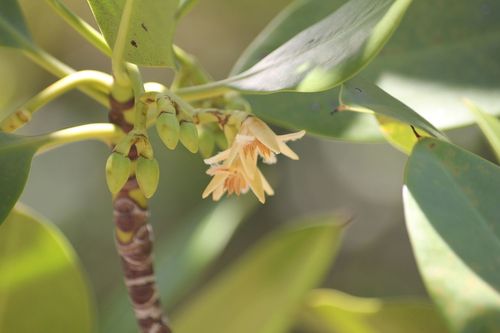
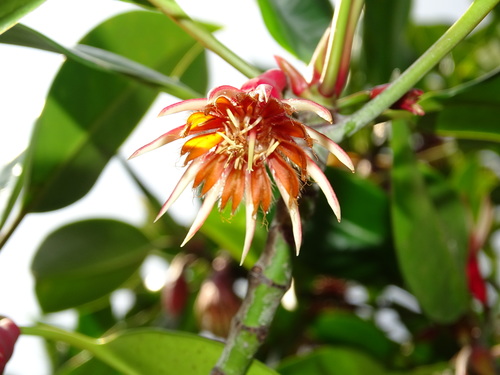
Bruguiera gymnorhiza (L.) Lam. is a tree that can reach up to 35 meters in height, though it most commonly grows between 7 and 20 meters. It has a glabrous, mostly smooth trunk with reddish-brown bark that is sometimes fibrous; the bark can also be light brown or grey. This species develops short prop-roots rather than long stilt-roots. Its green elliptic leaves are 5–15 cm long. Flowers grow singly, with white or cream petals that quickly turn brown, reaching up to 1.5 cm long, and a calyx that ranges from pinkish-green to reddish-brown. Fruits are turbinate, or spinning-top shaped, and 2 cm long. When mature, spindle-shaped fruits drop and embed upright in mud, where they rapidly develop roots. While still attached to the parent tree, seeds develop a hypocotyl up to 11 cm long. This tree is native to coasts bordering the Indian Ocean, the South China Sea, and parts of the western Pacific Ocean. Its native range includes Caroline Island, Samoa, Tonga, Wallis and Futuna, Fiji, Marshall Islands, Gilbert Islands, Nauru, Vanuatu, Solomon Islands, Queensland, New Guinea, Northern Territory, Lesser Sunda Islands, Sulawesi, Nansei-shoto, Borneo, Jawa, Hainan, Christmas Island, Southeast China, Cambodia, Vietnam, Sumatra, Peninsular Malaysia, Thailand, Myanmar, Bangladesh, Nicobar Islands, Andaman Islands, India (including Andhra Pradesh), Sri Lanka, Maldives, Mauritius, Madagascar, Aldabra, Seychelles, Somalia, Djibouti, Kenya, Mozambique Channel Islands, Tanzania, Mozambique, KwaZulu-Natal, and Cape Provinces. It is extinct in Taiwan and naturalized in Florida. It grows on intertidal mudflats and estuaries, at 0-2 meters elevation between mean sea level and the highest tide, in less exposed coastal areas with annual rainfall of 1000-8000 mm. On Pacific islands, it commonly grows alongside other mangrove species. It can grow in a wide range of soils, but grows best in river estuaries. Saltwater habitats with alluvial sediment allow it to spread via its adventitious roots. This black mangrove species is a protected tree in South Africa. It is primarily used for wood products, and has multiple agroforestry uses including woodlots, mulch and organic matter production, soil stabilization, coastal protection, windbreaks, providing wildlife and marine food and habitat, and serving as bee forage. Its wood is widely used for firewood, building construction (including structural components like poles, beams, and rafters), canoe parts, fishing stakes, spears, copra huskers, pulp production chips, tool handles, and digging sticks. In the Andaman Islands, trunks are used for telephone and transmission poles, as the wood appears rot-resistant, meaning it is durable when in direct contact with the ground. The wood has a high calorific value; it is used as fuel on some Pacific islands such as Kosrae, and for charcoal production in Indonesia and Cambodia. In the Marshall Islands, the wood is used for keel pieces (maal), outriggers (kie), and outrigger struts (kein-eon erre), and paddles are also made from the wood on some islands. The fruit, which acts as a propagule containing the hypocotyl, is reported to be edible after scraping, grating, washing, drying, and cooking to remove tannins; it is sometimes mixed with coconut in Melanesia and Nauru. The fruit is sold as a vegetable at Honiara Market in the Solomon Islands. For the Sowek people of Supiori Island, Papua Province, Indonesia, the fruit is a staple primary food in their diet due to its high carbohydrate content. The bark is used as an abortifacient and to treat burns in the Solomon Islands. In Indonesia, the bark is reported to be used to treat diarrhea and fever. The astringent and mildly toxic bark has also been used to treat malaria in Cambodia. The fruit of this species has antiviral properties. Bark extracts from the closely related Bruguiera sexangula are reportedly active against at least two types of cancerous tumors: Sarcoma 180 and Lewis lung carcinoma. The bark is used for dyeing, producing colors ranging from red-brown to black, which requires repeated dyeing. It has a high tannin content for tanning leather, but tends to produce excessive coloring unless collected at the end of each growing season. Green propagules and hypocotyls are also eaten by many indigenous groups in northern Australia. For example, in the Weipa region of northwestern Cape York Peninsula, the Thaynakwithi people (who speak the Thyanhngayth dialect of the Awngthim language) call this species nhomb, and prepare propagules by baking, mashing or pounding, then placing the flesh in a sieve-like woven bag before soaking in water. Among people of Wanigela, Northern (Oro) Province, in southeastern Papua New Guinea, cooked hypocotyls are eaten as one of their staples, and used in ethnomedicine as an antimicrobial and insecticide. Speakers of Batjamal and Emi of the Wadjiginy language, who live near Anson Bay in the Northern Territory, Australia, use the species’ durable hard wood to make spear tips (called batjagada in Batjama, ijinde in Emi) fitted with Bambusa arnhemica shafts. In Cambodia, the reddish fine-textured wood is used for local construction, including huts, wharves, fences, and fishery structures, and charcoal made from its wood is considered excellent. In Cambodia, the bark is also used to dye fishing nets and tan animal skins, and a bark decoction is taken to treat diarrhea. There is evidence that hypocotyls are eaten in India, Bangladesh, and other parts of Southeast Asia. In the Maldives, propagules or green pods are peeled, boiled with the water changed at least four times, and eaten as a cooked vegetable. Propagules of Bruguiera gymnorhiza are more appreciated than those of Bruguiera cylindrica.