About Bruguiera cylindrica (L.) Blume
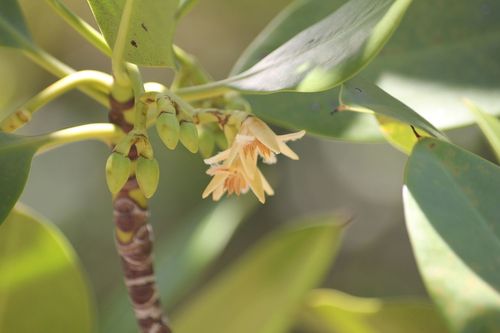
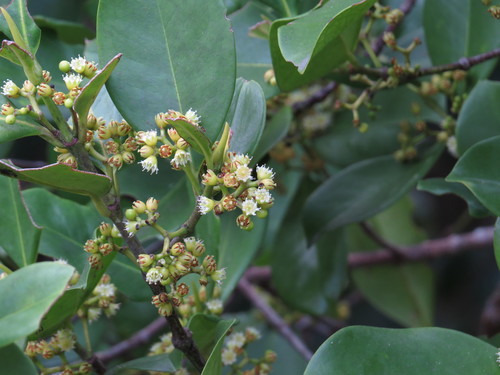
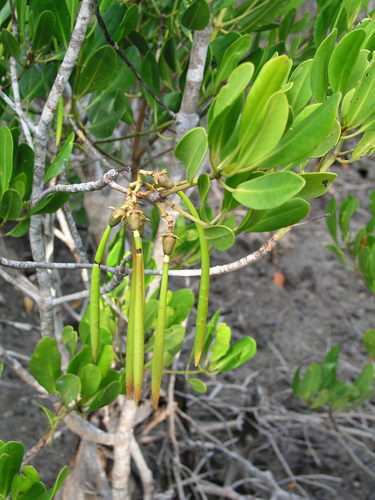
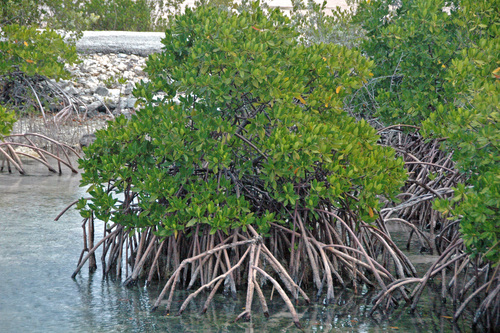
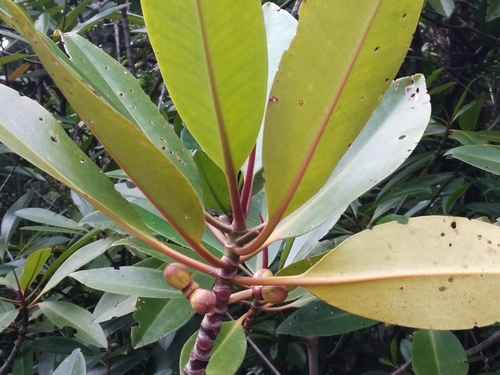
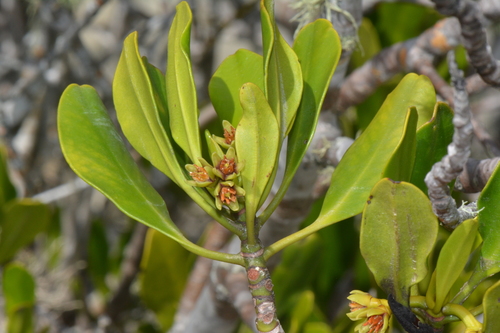
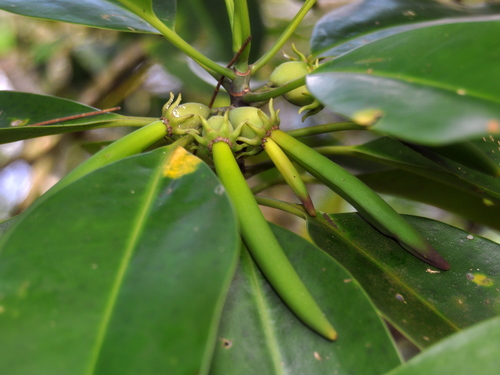
Bruguiera cylindrica (L.) Blume is usually a small tree reaching up to 20 meters (66 ft) tall, though it often grows in the form of a bush. Its bark is smooth and grey, with corky raised patches that hold lenticels—structures used for gas exchange. The trunk is supported by buttressed roots. This species produces aerial roots called pneumatophores, which grow out of the soil in knee-shaped loops. These pneumatophores also have many lenticels that let air enter the interconnected root system while keeping water out. The roots spread widely to give the tree stability in waterlogged soil. The leaves are glossy green, arranged oppositely, simple, elliptical, and have pointed ends. Flowers grow in small clusters of 2 to 5 in the axils of leaves. Each flower has 8 long green sepals and 8 smaller greenish-white petals, with several small bristles at the petal tip. Pollination happens via insects: when an insect probes the base of the flower with its mouthparts, the flower releases a cloud of pollen. This mangrove exhibits vivipary: the seed does not detach from the flower stalk, instead germinating in place to form a structure called a propagule. The mature propagule is a slightly curved cylinder up to 15 centimeters (5.9 in) long, with an upturned calyx still attached, and it resembles a slender, dangling cucumber. Propagules eventually drop off the parent tree, and first float horizontally. After a few weeks, the lower root portion absorbs water and becomes heavier, so the propagule shifts to a vertical floating position, ready to root into a suitable substrate. Bruguiera cylindrica can be mistaken for Bruguiera gymnorhiza, but B. gymnorhiza has larger red flowers and red sepals that stay attached to its propagule, which is a straight cylinder rather than slightly curved. Bruguiera cylindrica is distributed across tropical Asia, ranging from India and Sri Lanka through Malaysia, the Philippines, Thailand, Vietnam, Indonesia and New Guinea, extending to Queensland, Australia. It is one of the most common mangrove species in Singapore. It grows on newly deposited silt, often growing landward of other more salt-tolerant mangrove species like Avicennia. Unlike some other mangroves, it cannot easily regenerate from broken branches. Mangrove swamps where Bruguiera cylindrica grows host many species of marine fungi, and this tree is one of the species colonized by these fungi. The timber of Bruguiera cylindrica is dense, reddish, and strong, so it is used for construction. In the Maldive Islands, it is used for parts of canoe hulls, and especially for canoe keels. It burns well as firewood and can be processed into charcoal. Crushed bark from this tree has an unusual odor that repels fish, so its wood is not used to make fish traps. Despite this, extracts taken from its pneumatophores are used in perfume production. Various parts of the tree are edible: root tips are enjoyed as food in Thailand, bark is used as a spice, and young shoots are boiled and served as a vegetable. In the Maldives, propagules are boiled and eaten as a vegetable on the islands where the species grows. In traditional medicine, the skin of the fruit is used to stop bleeding, and leaves are used to lower blood pressure.