About Brugmansia suaveolens (Humb. & Bonpl. ex Willd.) Bercht. & J.Presl
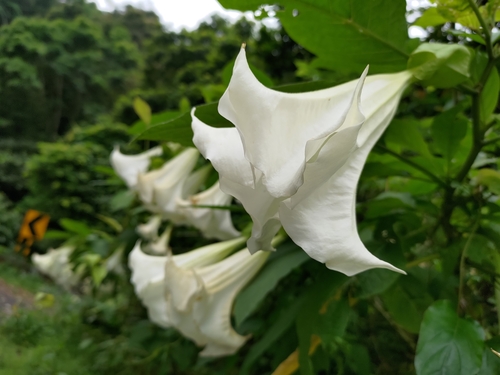
Brugmansia suaveolens is a semi-woody shrub or small tree that reaches 3–5 m (10–16 ft) in height, and often has a many-branched trunk. Its leaves are oval, growing up to 25 cm (10 in) long by 15 cm (6 in) wide, and they become even larger when the plant grows in shade. Most flowers of this species are white, though they may also be yellow or pink. They are sweetly scented during night and early morning, measure 24–32 cm (9–13 in) long, and have a trumpet shape that hangs downward, ranging from fully pendulous to nearly horizontal. The main corolla body curves slightly toward five main points; in true B. suaveolens, the very tips of these points always curve outwards, never roll back, and are short, between 1–2.5 cm (0.4–1.0 in) long. B. suaveolens was originally endemic to coastal rainforests of southeast Brazil, growing below 1,000 m (3,300 ft) along river banks and forest edges in areas with warm temperatures, high humidity, and heavy rainfall. Due to human interaction with the species, it now grows in residential areas across much of South America, and can also be found occasionally in Central America, Mexico, California, Greece, Africa, and parts of Florida. The species is invasive in New Caledonia. The plant's evening fragrance attracts pollinating moths; flowers stay half-closed during the day, and return to their peak opening and fragrance in the evenings. This species has two distinct life cycle stages. During the initial vegetative stage, a young seedling grows straight upward, usually on a single stalk, until it forms its first main fork at 80–150 cm (2.6–4.9 ft) high. It will not produce flowers until after this fork forms, and flowering only occurs on new growth above the fork. Cuttings taken from the lower vegetative region must also reach a similar height before flowering, but cuttings taken from the upper flowering region often flower when they are still very short. One notable plant-animal interaction involves the butterfly Placidula euryanassa, which uses B. suaveolens as one of its main larval food sources. The butterflies can sequester the plant's tropane alkaloids, storing these compounds through the pupal stage into adulthood. These stored alkaloids act as a defense mechanism that makes the butterflies less palatable to vertebrate predators. Every part of Brugmansia suaveolens is poisonous, with seeds and leaves being especially dangerous. Like other Brugmansia species, B. suaveolens contains high levels of scopolamine (hyoscine), hyoscyamine, atropine, and several other tropane alkaloids. Ingestion of plant material can cause effects including paralysis of smooth muscles, confusion, delusions, tachycardia, dry mouth, constipation, visual and auditory hallucinations, mydriasis, rapid onset cycloplegia, and death. Flower extracts of B. suaveolens have demonstrated pain-killing (antinociceptive) activity in mouse studies, and this activity may be partially linked to benzodiazepine receptors. In Rio Grande do Sul, southern Brazil, the flowers and seeds are traditionally mixed with water and ingested for an analgesic-like effect. The species is included on the Tasmanian Fire Service's list of low flammability plants, meaning it is suitable for planting within building protection zones. Many South American cultures use B. suaveolens in ritual practices. The Ingano and Siona peoples of the Putumayo region use it as an entheogen. Some Amazonian tribes add it as an admixture to increase the potency of Ayahuasca. In some South American countries, malevolent sorcerers or unethical shamans occasionally add B. suaveolens to ayahuasca brews to take advantage of unsuspecting tourists. According to genuine shamans, this is done to steal a person's energy or power, which they believe every person holds in a limited stockpile. Brugmansia species including B. suaveolens are grown as ornamental plants, grown outdoors year-round in non-freezing climates around the world. They do not tolerate temperatures that drop significantly below 5 °C (41 °F). Like other large-leaved, fast-growing plants, they benefit from some protection from wind and the hottest afternoon sun. They prefer organically rich soil, frequent watering, and heavy fertilizer during active growth. Both woody and leafy tip cuttings are used for propagation, though thicker cuttings better tolerate low humidity. In cooler northern regions, they are often grown in large containers, and overwintered in non-freezing garages or basements; they can also be grown in a sunny conservatory. Plants can be trained to grow as standards, with a single straight trunk. In UK cultivation, this plant has received the Royal Horticultural Society's Award of Garden Merit.