About Brotogeris sanctithomae (Statius Muller, 1776)
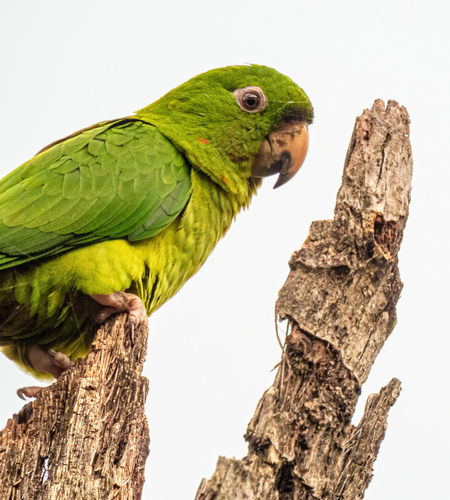
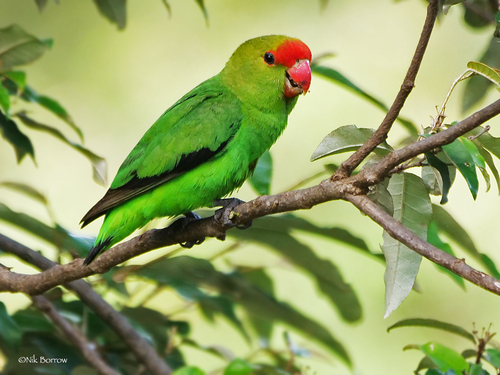
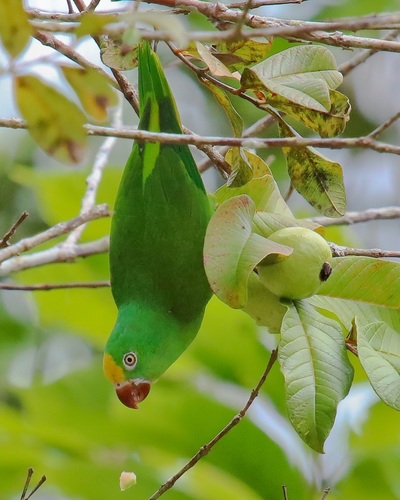
The tui parakeet (Brotogeris sanctithomae, originally described by Statius Muller in 1776) measures 17 to 19 cm (6.7 to 7.5 in) in length and has an average weight of 59 g (2.1 oz). Adult tui parakeets are primarily green, with a yellower tone on the rump and underparts. They have yellow lores and forehead, a bluish tinge on the face, darker green primaries than the rest of the body with bluish undersides, and a brown bill. The subspecies B. s. takatsukasae differs from the nominate subspecies only by the presence of an additional yellow streak behind the eye. Immature tui parakeets are essentially identical in appearance to adults.
The nominate subspecies of the tui parakeet occurs in the Amazon Basin, in extreme southeastern Colombia, eastern Peru, northern Bolivia, and Brazil extending east to the Rio Madeira. There are no documented sight records of the species from eastern Ecuador, so the South American Classification Committee of the American Ornithological Society classifies it as a hypothetical species in that country. Subspecies B. s. takatsukasae is found along the lower Amazon, from the Rio Madeira and Rio Negro east to the Atlantic Ocean at the Amazon's mouth. The tui parakeet mostly lives in semi-open landscapes, including secondary forest, grasslands with scattered woodland, riverbanks and islands with dense scrub, and the edges of várzea forest.