About Brotogeris chrysoptera (Linnaeus, 1766)
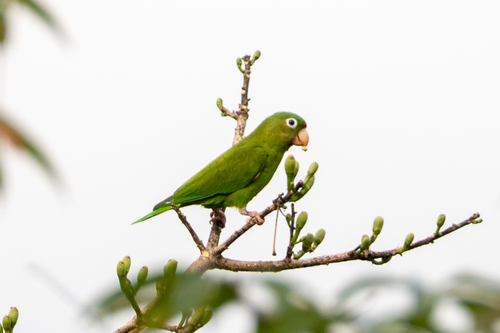
The golden-winged parakeet (Brotogeris chrysoptera) is approximately 16 cm (6.3 in) long and weighs between 47 and 80 g (1.7 to 2.8 oz). The species is almost entirely green across its body. Adult birds of the nominate subspecies have a brownish frontal band above the bill, an orange-brown spot on the chin, and bright orange primary coverts. Each recognized subspecies has distinct plumage traits: B. c. tuipara has an orange frontal band and chin, plus yellow edges on the outer tail feathers; B. c. chrysosema has a yellowish orange frontal band and yellow primary coverts; B. c. solimoensis matches B. c. chrysosema but has a paler frontal band; and B. c. tenuifrons shares the yellow outer tail feather edges of B. c. tuipara, but has no frontal band at all. Immature golden-winged parakeets have fully green wings. The different subspecies occupy separate geographic ranges: B. c. chrysoptera is found from northeastern Venezuela, extending southeast through the Guianas into adjacent north-central Brazil; B. c. tenuifrons occurs along the upper Rio Negro in northwestern Brazil; B. c. solimoensis lives in north-central Brazil along the middle Amazon, between the municipality of Codajás and Manaus; B. c. tuipara ranges across north-central Brazil south of the Amazon, between the Tapajós River and the Atlantic coast in Maranhão; B. c. chrysosema is found along the Madeira River and its tributaries, from northeastern Bolivia into western Brazil's Mato Grosso state. Across most of its overall range, the golden-winged parakeet lives in undisturbed lowland rainforest, secondary forest, savanna, coastal woodlands, and even human towns that have tall trees. North of the Orinoco River in Venezuela, it also inhabits cloudforest at elevations up to 1,200 m (3,900 ft).