About Bronchocela cristatella (Kuhl, 1820)
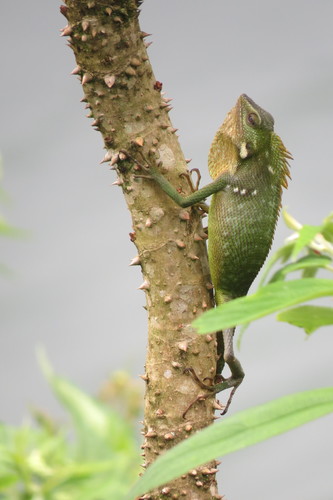
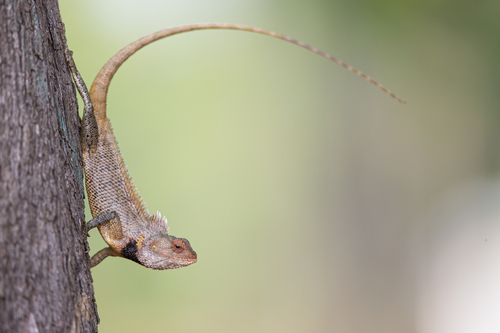
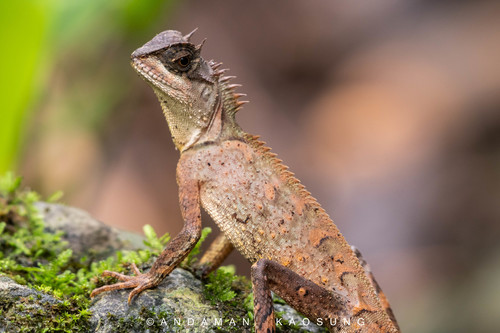
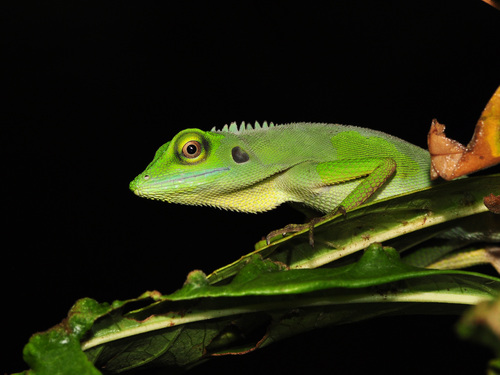
Bronchocela cristatella (Kuhl, 1820) is a species of lizard first formally described by C.A.L. Günther in 1864 in *The Reptiles of British India*. This lizard is typically bright green, sometimes with a blue tint on the head, and is capable of changing its color. When threatened, it turns darker brown; sudden color changes to grey, brownish, or blackish have also been observed, sometimes with orange spots, indistinct black network patterning, or large isolated round black spots appearing on the head, back, or around the tympanum. It has a dark ring around each eye and a dark spot at the back of the head. Males develop a crest on the neck. The nuchal crest is low, formed by triangular spines, and does not extend onto the back, where the vertebral scales are barely prominent. The body is 13 cm (5.1 in) long, with an extremely long, thin tail that makes up 75% of the lizard’s total length, for a total combined body and tail length of 57 cm (22 in). Some sources have recorded this species reaching a total length of 20 inches, with the tail measuring 16 inches. Scales on the sides are small, with around 40 scales in one transverse series. Ventral scales are much larger, arranged in 14 longitudinal rows. A short series of three or four larger scales continues the superciliary margin, and no other large scales are present on the temple. On the hind foot, the fourth toe is one-eighth longer than the third toe. This species is very common in Malayan countries and many islands of the East Indian Archipelago, including Sumatra, Java, Amboyna, Celebes, Borneo, Booroo, and the Philippines. Its confirmed geographic range includes Malaysia (West Malaysia and Borneo), Singapore, Indonesia, the Philippines (Palawan, Calamian Islands, Panay, Luzon), southern Thailand, southern Myanmar (Tenasserim Hills), and India (Nicobar Islands). B. cristatella inhabits forests, as well as parks and rural areas. It moves and leaps very quickly among tree branches.