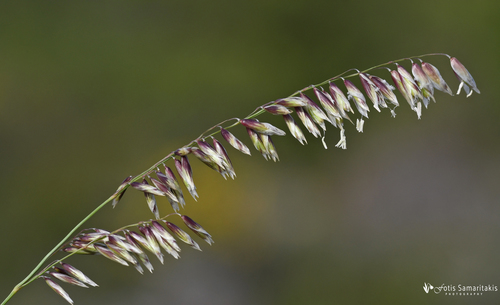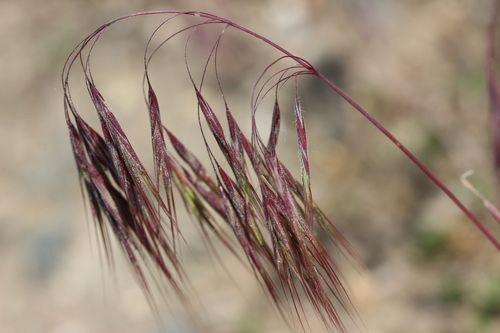
About Bromus tectorum L.
The genus name Bromus comes from a Greek word for a type of oat, while the specific epithet tectorum comes from the Latin possessive form of tector, meaning "of the overlayment (roof)". Bromus tectorum L. is a winter annual grass native to Eurasia. It usually germinates in autumn, overwinters as a seedling, then flowers in spring or early summer. B. tectorum is often mistaken for a bunchgrass, because it may produce shoots that give it the appearance of a rosette. When growing in dense stands, however, the plant does not form this rosette-like structure and instead grows as a single-culmed (single-stalked) plant. Its stems are smooth (glabrous) and slender. Its leaves are hairy (pubescent), with leaf sheaths that are separate except at the node where the leaf attaches to the stem. This species typically grows 40–90 cm (16–35 in) tall, though plants as small as 2.5 cm (0.98 in) can produce seed. The flowers of B. tectorum are arranged on a drooping panicle that holds approximately 30 awned spikelets, each of which contains five to eight flowers. It is cleistogamous (self-pollinating, with non-opening flowers) and has no evident outcrossing. B. tectorum has a fibrous root system with few main roots that do not extend more than one foot into the soil. It also has wide-spreading lateral roots that let it absorb moisture efficiently from light precipitation events. This species can reduce soil moisture to the permanent wilting point (the minimal soil moisture required for a plant to avoid wilting) down to a depth of 70 cm (28 in), which reduces competition from other plant species. There is a positive correlation between healthy native vegetation communities and biological soil crust (BSC). BSC is a community made up of cyanobacteria, algae, lichens, and mosses that live on the soil surface. In arid regions, BSCs colonize the spaces between plants, increase local biodiversity, are often the dominant ground cover, and are critical to healthy ecosystem function. In addition to controlling erosion, BSC plays a key role in nutrient cycling and carbon fixation. Fire and trampling by cattle are the main threats to BSC communities. Once BSC is disturbed, it can take decades or even centuries to reform. A decline in BSC community health acts as an early warning indicator of B. tectorum invasion. When the BSC community is healthy, it hinders B. tectorum germination and lowers the chance of successful invasion. If BSC is disturbed, however, and B. tectorum becomes established, it will then hinder the recovery of the BSC community. Native perennial grasses usually have roots that reach as deep as four feet into the soil. These roots add organic matter that feeds soil organisms, which assist with water and nutrient cycling in arid ecosystems and improve overall soil quality. Because B. tectorum has a shallow, spreading root system, it is far more efficient at absorbing moisture from light precipitation events, and its presence disrupts natural nutrient cycling. Multiple studies have found that native plant biomass, especially biomass from native bunchgrasses, has a negative effect on B. tectorum cover and biomass. This indicates that a diverse native perennial plant community is more resistant to B. tectorum invasion. Studies have identified Poa secunda, Pseudoroegneria spicata, and Achnatherum thurberianum as key native grasses that provide resistance to B. tectorum invasion. These three grasses have differing life strategies that create constant interaction and competition with B. tectorum. P. spicata and A. thurberianum are deep-rooted and complete most of their growth in late spring, while P. secunda is shallow-rooted and completes most of its growth in late winter and early spring. Perennial grass ecosystems are less prone to intense burning. B. tectorum has historically been thought to create a positive feedback loop that increases its own population through increased fire frequency. However, Taylor et al. (2014) suggest that fire alone does not promote B. tectorum expansion. If an area burns, B. tectorum cover and biomass do not increase as previously assumed, and instead recover to pre-burn levels. Increased fire frequency caused by B. tectorum may serve to maintain, rather than increase, B. tectorum populations by preventing the establishment of native plant species. B. tectorum can grow in a wide range of climates, and is found primarily in regions with 150–560 mm (5.9–22.0 in) of annual precipitation. It can grow in almost any soil type, including the B and C horizons of eroded areas, and in areas with low nitrogen levels. B. tectorum colonizes disturbed areas quickly. It is most often found on coarse-textured soils, and does not grow well on heavy, dry, and/or saline soils. It grows within a relatively narrow range of soil temperatures: growth starts at 2.0–3.5 °C (35.6–38.3 °F) and slows when temperatures rise above 15 °C (59 °F).