About Bromus ciliatus L.
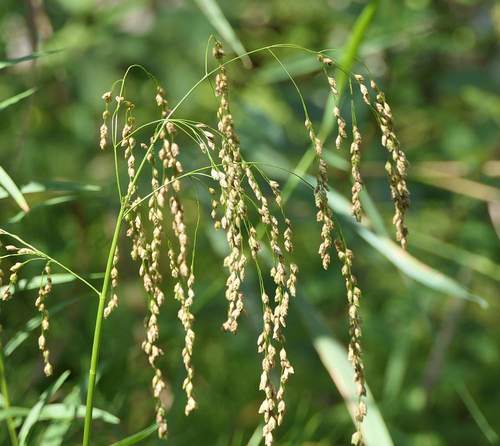
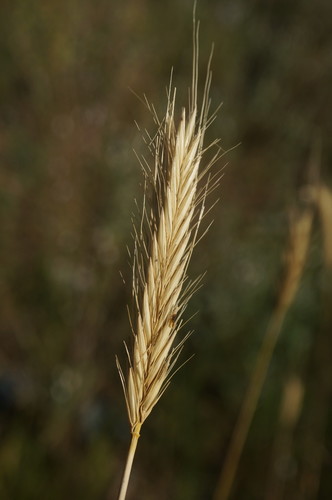
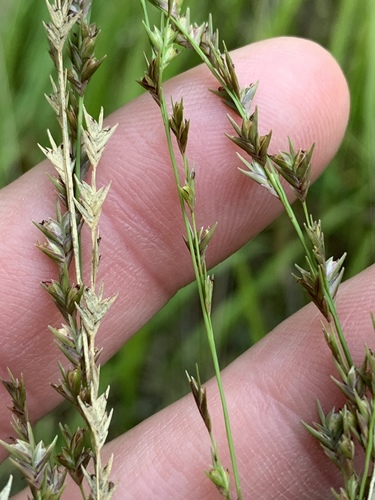
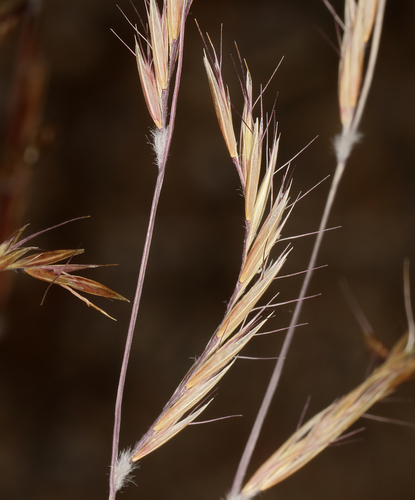
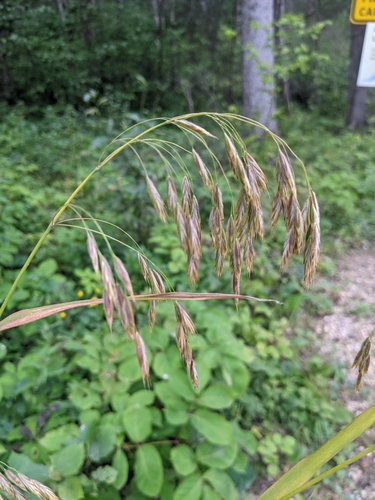
Bromus ciliatus L. is a perennial tuft-forming grass that grows up to 1.2 meters (3 feet 11 inches) tall, and occasionally reaches greater heights in the Great Plains. This grass does not have rhizomes, but it has a well-developed root system. Its leaf sheaths are either hairless or covered in minute hairs, with a narrow V-shaped orifice, and are typically shorter than the stem internodes. Its scabrous leaves, which are 3–16 mm (0.12–0.63 in) wide, often bear sparse long hairs. It produces an open inflorescence, that holds many spikelets on stalks; the upper spikelet stalks grow ascending, while the lower ones nod or droop. This panicle measures 10–30 cm (3.9–11.8 in) long. The flattened spikelets are 1.5–3 cm (0.59–1.18 in) long and 4–10 mm (0.16–0.39 in) wide. They are greenish, and occasionally tinged with bronze or purple. Each spikelet holds three to nine flowers, and exposes its rachilla when mature. The glumes are conduplicate, with the upper glume tapering at its base. The firm lemmas are also conduplicate, measuring 2.5–3.5 mm (0.098–0.138 in) broad and having delicate nerves. The linear palea is typically enclosed by the folded lemma. The anthers are 1–2.5 mm (0.039–0.098 in) long, and the caryopsis is lanceolate in shape. This grass flowers from July through early October. Bromus ciliatus is common in subalpine areas. It is a very palatable forage grass that is heavily grazed, and is shade tolerant. It grows in a wide range of moist conditions, including wet woodlands, moist meadows, thickets, stream banks, pond and lake margins, bogs, and marshes.