About Bromus catharticus Vahl
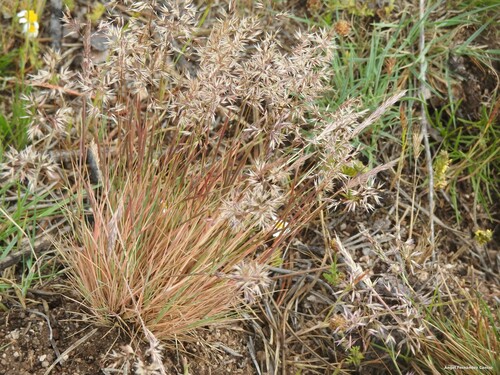
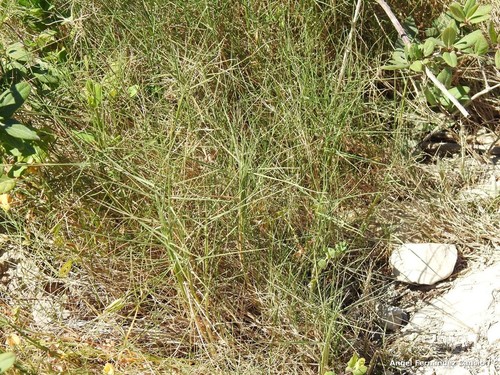
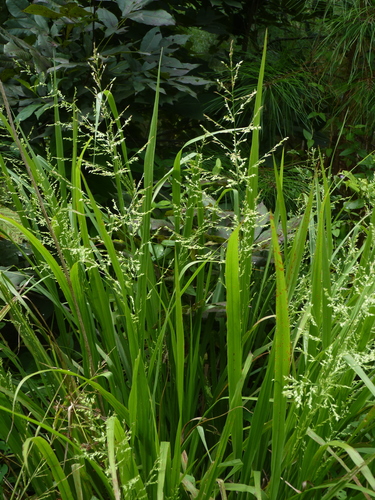
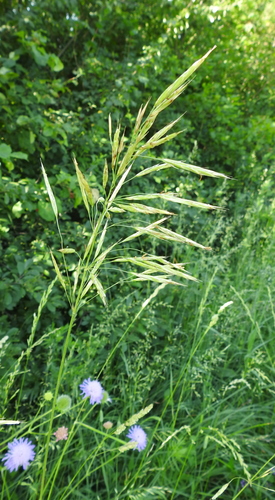
Bromus catharticus Vahl is a coarse winter annual or biennial grass, reaching 0.2–1 m (7.9 in – 3 ft 3.4 in) in height. Its culms are glabrous and 2–4 mm (0.079–0.157 in) thick, while leaf sheaths are densely hairy. This species does not have auricles, and its glabrous ligule measures 1–4 mm (0.039–0.157 in) long. Leaf blades are 4–30 cm (1.6–11.8 in) long and 3–10 mm (0.12–0.39 in) wide, and they are either glabrous or pubescent.
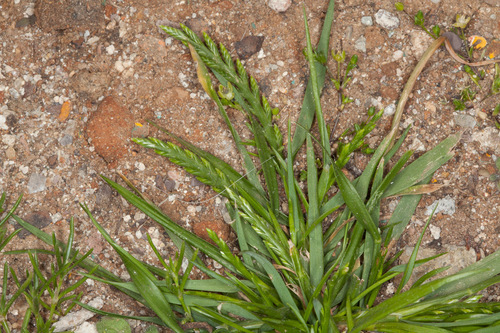
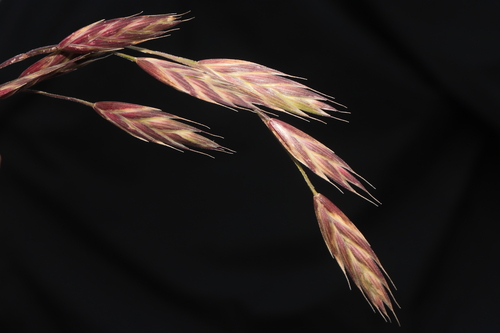
Erect or nodding panicles grow 9–28 cm (3.5–11.0 in) long. Upper spikelets are erect, and lower spikelets are nodding or drooping. Each flat, pointed spikelet is 20–40 mm (0.79–1.57 in) long and holds four to twelve florets. Glumes are smooth, or occasionally slightly scabrous: the lower glume is five to seven-veined and 7–12 mm (0.28–0.47 in) long, while the upper glume is seven to nine-veined and 9–17 mm (0.35–0.67 in) long. Lemmas are scabrous or nearly glabrous, either awnless or bearing very short awns up to 2 mm (0.079 in) long; lemmas themselves measure 11–20 mm (0.43–0.79 in) long. The palea is more than half the length of the lemma, and anthers measure 0.5–5 mm (0.020–0.197 in) long.
This species belongs to Bromus section Ceratochloa, which is distinguished from other Bromus sections by its strongly keeled lemmas—folded like the keel of a boat—that create laterally compressed spikelets. Bromus catharticus is native to most of South America, including Venezuela, Brazil, Bolivia, Colombia, Ecuador, Peru, Argentina, Chile, Paraguay, and Uruguay. It has been widely introduced and naturalised across many regions: in Africa, this includes Algeria, Egypt, Ethiopia, Lesotho, Morocco, Namibia, South Africa, Tunisia, and Zimbabwe; in Australasia, it is found in Australia, New Caledonia, and New Zealand; in Asia, it occurs in Azerbaijan, Bhutan, China, Cyprus, Georgia, India, Indonesia, Iran, Israel, Japan, Jordan, North Korea, South Korea, Nepal, Pakistan, Saudi Arabia, Russia, Sri Lanka, Syria, and Taiwan; in the Caribbean, it grows in the Dominican Republic, Jamaica, Haiti, and Trinidad and Tobago; in Central America, it is present in Costa Rica, El Salvador, Guatemala, and Panama; in Europe, it can be found in Austria, Belgium, Croatia, Great Britain, France, Germany, Greece, Italy, Switzerland, Russia, and Ukraine; and in North America, it occurs in Canada, Mexico, and the United States, including Hawaii.
Bromus catharticus grows in open, disturbed areas such as roadsides, parks, gardens, orchards, vineyards, and ditches. In Australia, it can also be found in certain natural habitats including coastal vegetation, heathlands, grasslands, grassy woodlands, open woodlands, and riparian areas. It is commonly used as a pasture grass in warm and temperate climates.