About Bromus arvensis L.
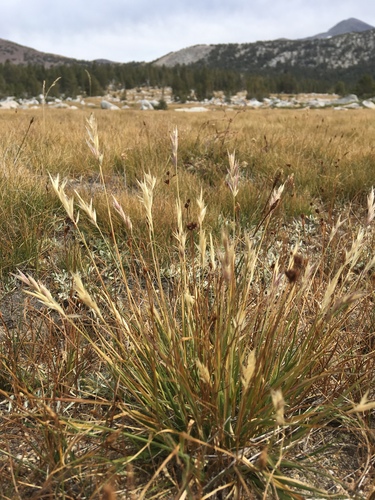
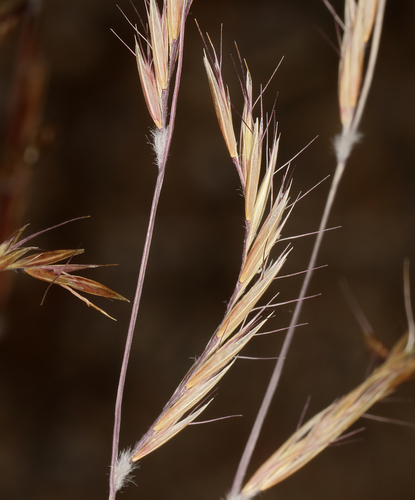
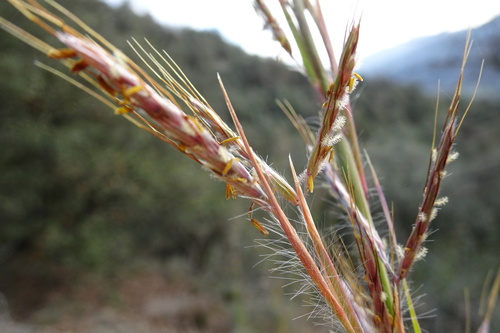
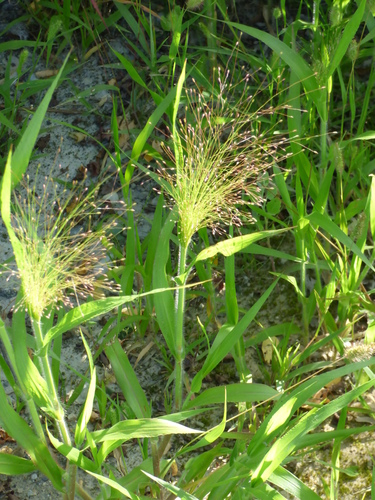
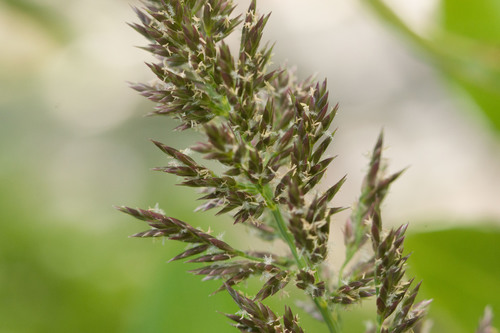
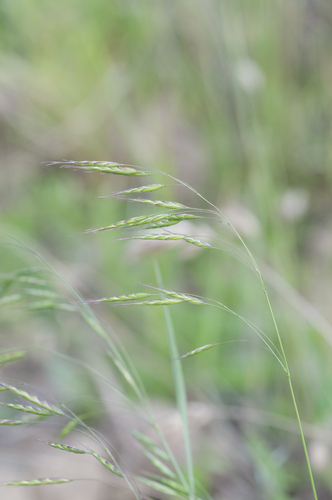
Bromus arvensis is an annual or biennial grass with erect culms that reach 0.3–0.9 m (1 ft 0 in – 2 ft 11 in) in height. This species has an extensive fibrous root system. Its leaf sheaths are softly pubescent, and its leaf blades are pubescent on both surfaces. Leaf blades measure 10–20 cm (3.9–7.9 in) long and 2–6 mm (0.079–0.236 in) wide. Obtuse ligules are 1–1.5 mm (0.039–0.059 in) long. Large, open panicles are 10–30 cm (3.9–12 in) long and 4–20 cm (1.6–7.9 in) wide, with ascending branches that droop at their tips. The straight or slightly curved branches are typically longer than the spikelets. Lanceolate spikelets are 1.5–3 cm (0.59–1.18 in) long and turn purplish when mature. Spikelets have long pedicels and bear five to twelve flowers each. At maturity, the bases of the florets may be either concealed or visible. Glumes are glabrous; lower glumes are three-veined and 4–6 mm (0.16–0.24 in) long, while upper glumes are five-veined and 5–8 mm (0.20–0.31 in) long. Obtuse lemmas are glabrous or slightly scabrous, measuring 7–8 mm (0.28–0.31 in) long and 1.1–1.5 mm (0.043–0.059 in) wide, with seven faint nerves. Lemma margins are translucent and terminate in long, acute teeth. Straight awns are 7–10 mm (0.28–0.39 in) long. Anthers are approximately 4 mm (0.16 in) long. Caryopses are shorter than the paleas and may be either weakly or strongly rolled inwards. This grass flowers in June and July. Bromus arvensis grows along roadsides, in disturbed areas, and in fields. It is native to southern and central Europe, but is now naturalized as a weed throughout temperate regions, including North America and Asia. This species acts as a soil improver and is useful for erosion control.