About Bromheadia finlaysoniana (Lindl.) Miq.
Bromheadia finlaysoniana is a terrestrial, evergreen herb that has flattened yellowish stems. The stems are 1–1.5 m (3–5 ft) long, and bear tough, stiffly spreading leaves that range in shape from elliptic to egg-shaped. Leaves are 100–150 mm (4–6 in) long and 20–30 mm (0.8–1 in) wide.
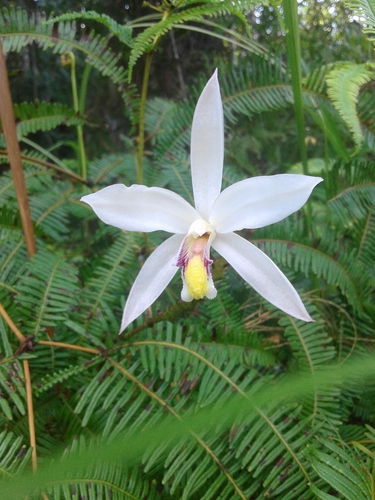
Its flowering stems are 100–200 mm (4–8 in) long, with a short zig-zag shaped end. Up to seventy-five single white flowers open in succession along this end. The flowers are 35–45 mm (1–2 in) long, 30–40 mm (1–2 in) wide, and are pinkish on the outside. Sepals are elliptic to egg-shaped, 25–50 mm (1–2 in) long and 7–9 mm (0.3–0.4 in) wide. Petals are egg-shaped and a similar length to the sepals, but broader than the sepals. The labellum is pale yellow, about 21 mm (0.8 in) long and 15 mm (0.6 in) wide, and has three lobes with erect side lobes.
Flowering occurs between June and March in Australia, and as late as October in New Guinea.
Bromheadia finlaysoniana has a wide distribution that includes Myanmar, Thailand, Cambodia, Laos, Vietnam, the Malay Peninsula, Singapore, Sumatra, Borneo, Brunei, the Moluccas, New Guinea, the Cape York Peninsula in Queensland, the Anambas Islands, and possibly the Philippines. It remains uncertain whether the specimens assigned to the Philippines were actually collected there. This plant grows in wet areas, usually near streams, at altitudes between 0 and 200 metres. In Queensland, Australia, it grows from the northern tip of Cape York Peninsula south to Hopevale. A cDNA for the enzyme dihydroflavonol 4-reductase has been cloned from Bromheadia finlaysoniana.