About Brodiaea santarosae T.J.Chester, W.P.Armstr. & Madore
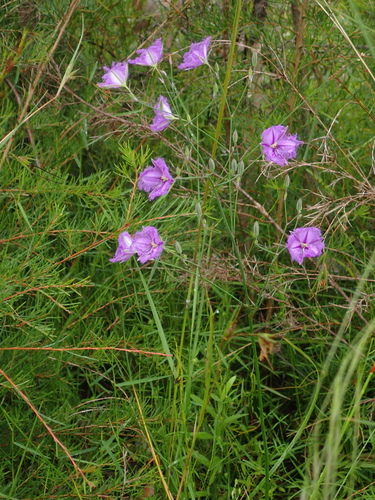
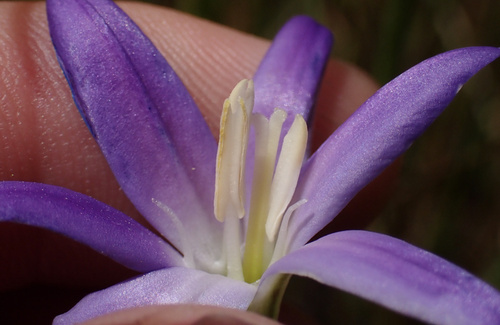
Brodiaea santarosae is a perennial plant that produces an inflorescence bearing bright purple flowers, which fade to white toward the base of the flower. Each flower has six spreading tepals, with a center holding three stamens plus staminodes—flat, sterile stamens that lie against the tepals. This species shows wide variation in staminode form: roughly 10% of flowers have no staminodes, 5 to 10% have short staminodes that curve backwards, and all remaining flowers have long staminodes. The plant grows from corms, which it uses for reproduction. Observed variation in floral part lengths and pedicel length in B. santarosae is potentially caused by the tall grasses that grow around it in its native habitat. This species is concentrated specifically in the Santa Rosa Basalt area of Riverside County, California, which is located south of San Bernardino County and north of San Diego County. It flowers between May and June, growing at elevations between 510 and 1050 meters. It is tolerant of low water conditions and can grow even in disturbed habitats, unlike the related species B. filifolia and B. orcuttii, which grow in wetter habitats. The primary threat leading to its endangerment is loss of native habitat from erosion of Santa Rosa Basalt; 97% of this original habitat has been lost. The remaining intact basalt covers approximately 15 square kilometers, and the plant's total range matches this area and is unlikely to extend beyond it.