About Briza media L.
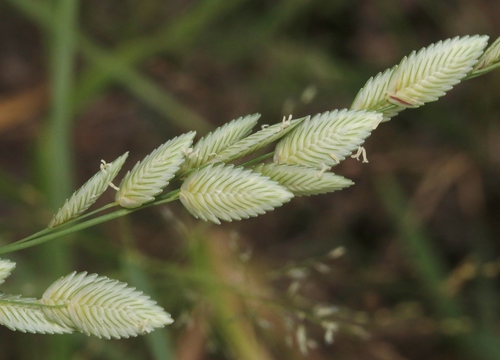
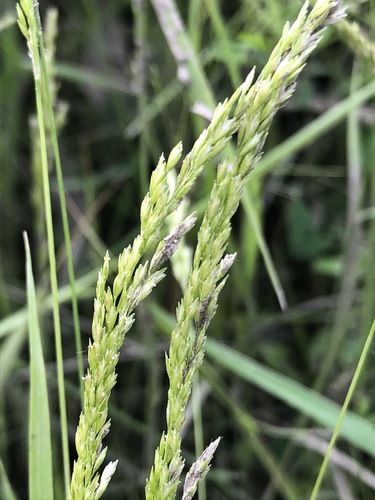
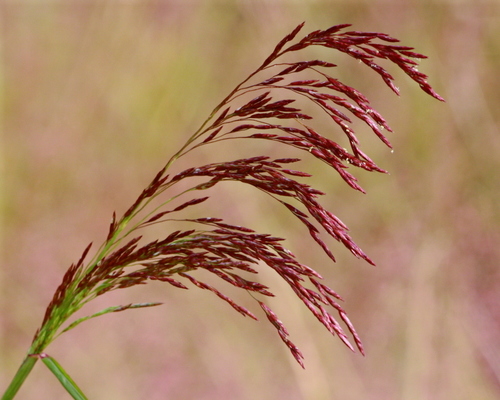
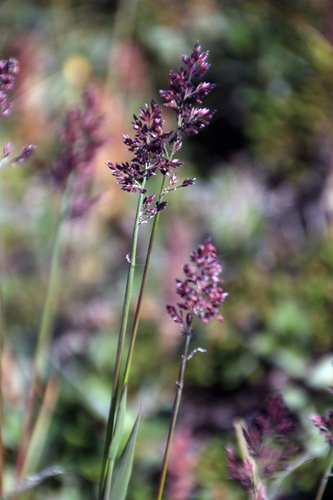
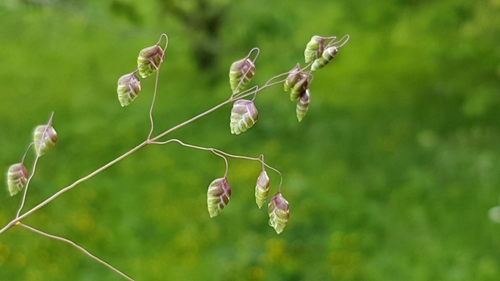
Briza media L. is a loosely tufted perennial grass with short rhizomes that grow from vegetative shoots. In the United Kingdom, it flowers from June to September. It is distinguished by its fine stems and distinctive hop-shaped green and purplish spikelets. Its culms typically grow 15 to 60 cm tall. Its hairless leaves are dull, ranging from glaucous to mid-green, usually 4 to 20 cm long and 2 to 4 mm wide. The leaves have minute forward-pointing hairs and a slender boat-shaped tip. The plant produces loose, roughly pyramidal panicles that are 4 to 10 cm long, holding up to 20 branches and 60 spikelets. Its spikelets are 4 to 7 mm long, loosely scattered, drooping, laterally compressed, and shaped elliptic to ovate. This grass is native and widely distributed across Britain and Europe, except for the extreme north of the region. It is common in England and Wales but rare in northern Scotland. It is not found in Iceland, the Faroe Islands, the Isles of Scilly, or the far north and far south of Ireland. It has been introduced to North America, where it occurs in Connecticut, Massachusetts, Michigan, and Vermont in the United States, and in British Columbia and Ontario in Canada. Briza media L. is a characteristic species of unimproved species-rich grassland, grazed calcareous grassland and pasture, fens, old meadows, scree slopes, quarry soils, and roadside verges. Many farmland bird species consume its seeds. It is a poor competitor, so high densities of neighboring plants in unmanaged grassland negatively impact it. It is able to tolerate a relatively high grazing regime. Predominantly a species of calcareous grassland, it occurs with high constancy in multiple plant community types defined by the UK National Vegetation Classification. This includes but is not limited to the calcareous grassland communities CG1 Festuca ovina – Carlina vulgaris through CG10 Festuca ovina – Agrostis capillaris – Thymus praecox, as well as the mesotrophic grassland community MG3 Anthoxanthum odoratum – Geranium sylvaticum. It is grazed by several insect species, including the larvae of Leptopterna ferrugata, Apamea scolopacina, and Phytomyza nigra, as well as the larvae and adults of Eriophyes tenuis. Feeding by Eriophyes tenuis causes leaf rolling and plant sterility.