About Brissus latecarinatus (Leske, 1778)
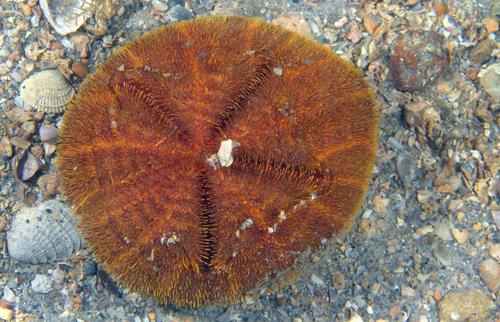
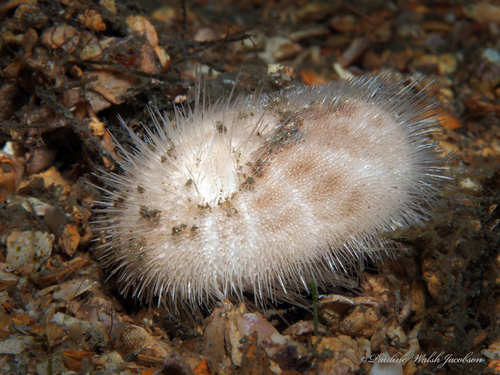
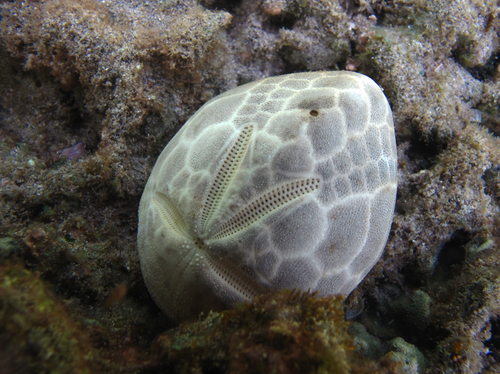
Brissus latecarinatus (Leske, 1778) is covered in short spines that come in brown, pink, and green. It has a crescent-shaped mouth and a large anal opening on its underside. A five-part petaloid pattern appears across its surface. Large individuals can reach 7 inches (180 mm) in length. This species occurs throughout the Indo-Pacific region, found in tropical waters of the Indian Ocean, Western Pacific, and all oceans that connect these two bodies of water. It lives on reefs at depths up to 45 feet (14 m). Like other members of the class Echinoidea, Brissus latecarinatus is gonochoric, with separate male and female individuals, and uses external fertilization. During brooding, eggs are retained on the peristome, near the periproct, or deep inside concavities on the petaloids. Embryos develop into planktotrophic echinoplateus larvae, which then settle to the seafloor, cling to the substrate using their tube feet, and eventually metamorphose into juvenile urchins. This entire developmental process takes many months. Overall, the life cycle of Brissus latecarinatus matches that of other sea urchins.