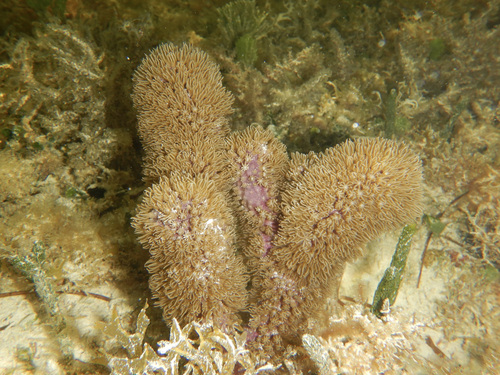
About Briareum asbestinum (Pallas, 1766)
Briareum asbestinum forms large, vertical, unbranched cylindrical growths commonly called fingers. These finger-like structures can grow up to one meter in length. Their morphology varies with water depth: fingers found at a shallow depth of 5m are shorter and stouter than those found at deeper sites up to 35m. Shallow water morphs also have shorter sclerites than deepwater morphs. This phenotypic plasticity is caused by unknown environmental factors, though potential causes include predation, reduced light intensity at greater depths, or increased fragility in shallow waters. Deeper colonies also have lower polyp density and thinner colony thickness. This species' polyps grow over 1cm in size, giving the coral's surface a hairy appearance. The coral's surface underlayer may be colored purple, grey, tan, brown, or greenish-brown. Briareum asbestinum occurs in shallow tropical waters of the western Atlantic Ocean and Caribbean Sea, at depths up to 35m. It can be abundant in back-reef areas and on coral rubble, and is also found growing in seagrass beds. Briareum asbestinum is capable of both sexual and vegetative reproduction. Sexual reproduction occurs through the annual release of gametes into the water column. Vegetative reproduction happens when broken fragments of the coral settle on the ocean floor and colonize suitable new sites.

