About Breviceps namaquensis Power, 1926
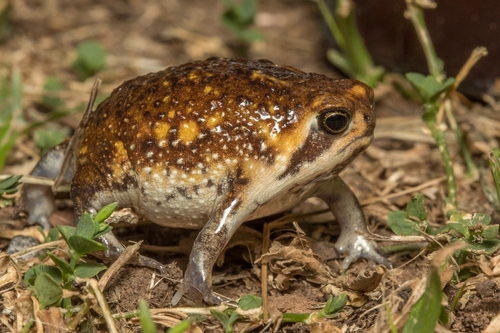
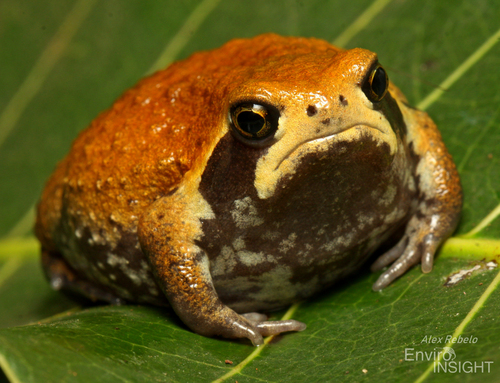
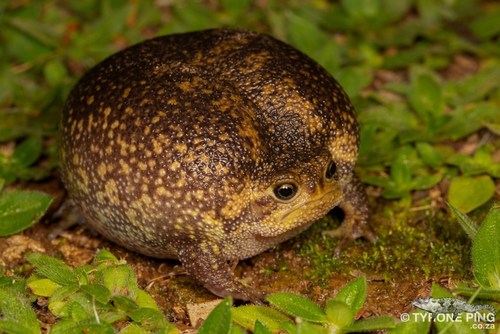
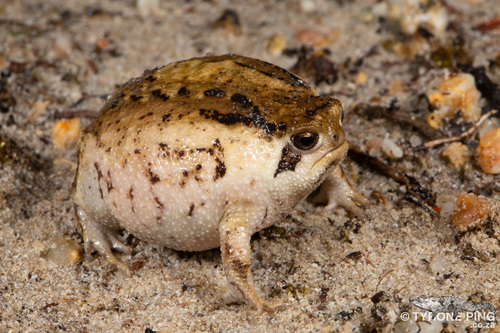
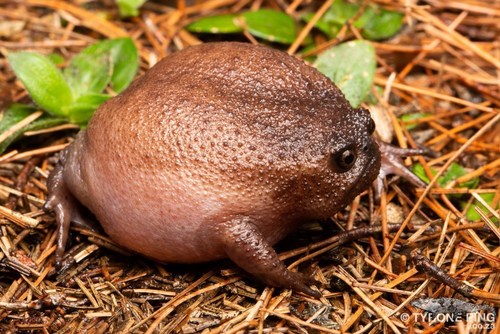
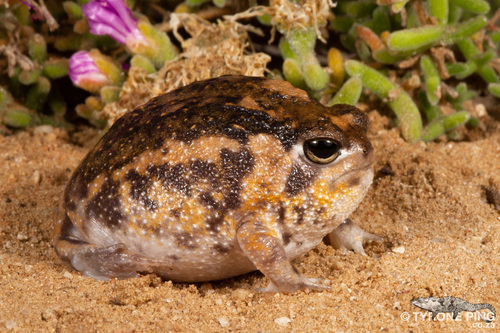
Identification: Adult Breviceps namaquensis reach a body length of 46 mm (1.8 inches). This species, commonly called the Namaqua rain frog, has a squat, round body paired with a short, narrow head that has relatively large eyes, a flat face, and a narrow mouth. Its limbs are short and stumpy, and its fingers and toes have no webbing or adhesive discs. The upper surface of the body is brown, with lighter brown to cream patches across the back and sides. These patches occasionally fuse together, and may include irregular pairs of paravertebral patches. The underside is mostly smooth and white, with partially translucent skin; the throat area may be granular, with dark markings along the jaw line. The Namaqua rain frog is almost indistinguishable from the Desert rain frog. Habitat and conservation: The Namaqua rain frog is a fossorial (burrowing) frog that lives in scrub-covered sandy areas within the succulent karoo biome. Its development is direct, meaning there is no free-living larval stage, and it does not require an aquatic habitat. It is locally abundant, but faces some habitat loss from agricultural expansion in the southern part of its range. It occurs within several protected areas.