About Breviceps mossambicus Peters, 1854
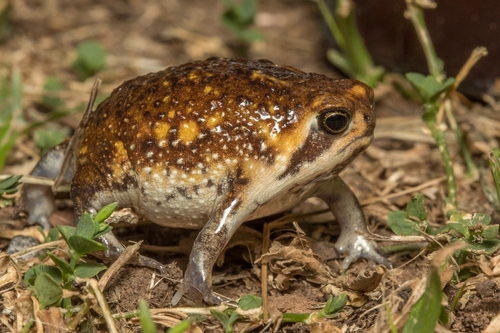
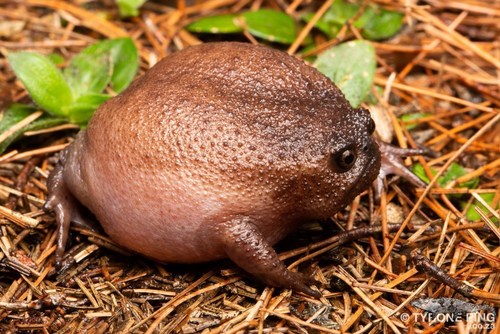
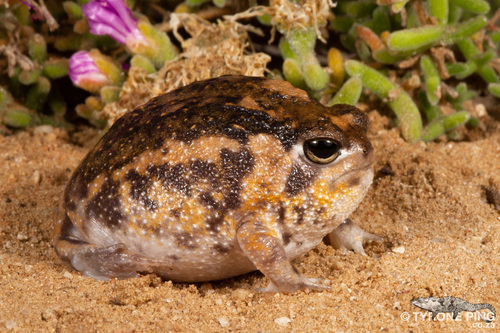
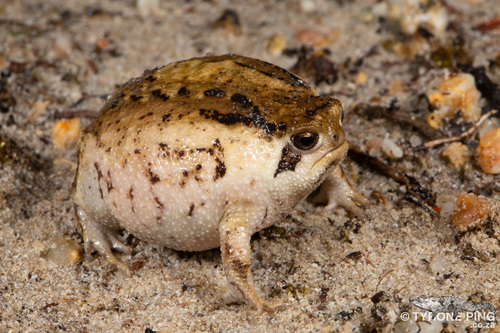
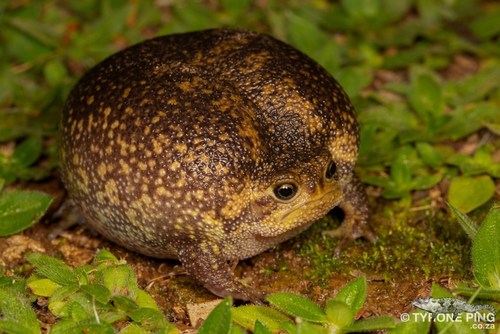
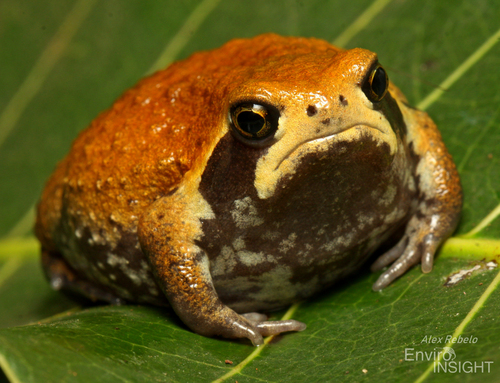
The Mozambique rain frog (Breviceps mossambicus Peters, 1854) is a sturdy, stout frog with short legs and a blunt snout. Females reach a snout-to-vent length of roughly 52 millimetres (2.0 in). Its dorsal surface is greyish-brown, speckled with darker coloration. A dark streak connects the eye and the front leg, running over the tympanum. The belly is white with dark blotches, and breeding males have a brown-colored throat. The frog's feet are unwebbed, and its outer two toes are much smaller than the other toes on each foot. This species can be misidentified as Callulina kreffti, though C. kreffti is more arboreal and has square-ended toepads that help it climb trees. Breviceps fichus is very similar in appearance to the Mozambique rain frog, but the advertisement calls of the two species differ significantly. The Mozambique rain frog has a widespread distribution across central and southern Africa. Its range extends from the Democratic Republic of the Congo and Tanzania in the north to the Republic of South Africa in the south. Its natural habitats are savanna, bushy terrain, and open woodland, particularly the moister sections of these landscapes. It occurs in lowlands and on the lower slopes of mountainous regions, up to an elevation of 1,800 metres (5,900 ft) above sea level. It is an adaptable species that appears able to tolerate habitat degradation.