About Branta sandvicensis (Vigors, 1834)
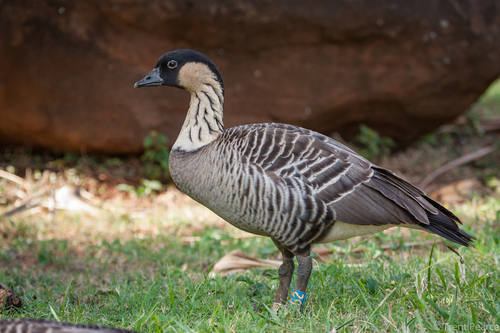
The nene, Branta sandvicensis, is a large goose that reaches 41 cm (16 in) in height. While it spends most of its time on the ground, it is capable of flight, and some individuals fly daily between their nesting and feeding areas. Females weigh between 1.525–2.56 kg (3.36–5.64 lb), while males average 1.695–3.05 kg (3.74–6.72 lb), making males 11% larger than females. Adult nenes have a black head and hindneck, buff-colored cheeks, and a deeply furrowed neck marked with diagonal black and white stripes. The adult's bill, legs, and feet are all black. Their webbed feet have evolved for walking on lava, and the webbing is reduced from the toes. Nenes also have soft feathers under their chins. Goslings look similar to adult nenes, but have duller brown plumage, less distinct color separation between the head and neck, and much less prominent neck striping and body barring. Nenes live in shrublands, grasslands, coastal dunes, lava plains, and associated human-altered habitats such as pastures and golf courses, at elevations ranging from sea level up to 2,400 m (7,900 ft). Some nene populations migrate between lowland breeding grounds and mountain feeding areas. Historically, nenes could be found on the Hawaiian islands of Hawaiʻi, Maui, Kahoʻolawe, Lānaʻi, Molokaʻi, Oʻahu, and Kauaʻi. Today, their native range is limited to Hawaiʻi, Maui, Molokaʻi, and Kauaʻi. In January 2014, a pair of nenes arrived at James Campbell National Wildlife Refuge on Oʻahu; two of their offspring survived and are seen regularly on the nearby golf courses at Turtle Bay Resort.