About Branta ruficollis (Pallas, 1769)
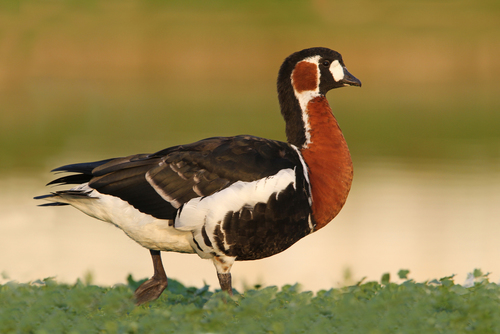
All species in the genus Branta are set apart by their dark sooty plumage patterned with white, which distinguishes them from the grey geese of the genus Anser. Among all species from these two genera, the red-breasted goose (Branta ruficollis) is the smallest, measuring 53–56 cm (21–22 in) in total length. This distinctly marked species is easy to identify when seen clearly, but can be surprisingly hard to spot when mixed in with other brant geese. At long distances, the red colouring of its breast often appears dark. The red-breasted goose breeds in Arctic Siberia, with most of its breeding population concentrated on the Taymyr Peninsula, and smaller breeding populations found on the Gyda and Yamal peninsulas. Most of the species winters along the northwestern shores of the Black Sea in Bulgaria, Romania, and Ukraine, and individuals will occasionally move further southwest into Greece; a smaller number of red-breasted geese winter in Azerbaijan. It is a rare vagrant to Ireland and other parts of Western Europe, where it is sometimes found mixing with flocks of Brent or barnacle geese. Because red-breasted geese are common in captive wildfowl collections, escapees outside of the species' natural range are fairly common. Historically, a large portion of the global red-breasted goose population wintered in Kirov Bay on the Caspian Sea. In the 1960s, this area became unsuitable for wintering geese due to agricultural change: vineyards and cotton replaced the cereal crops the geese relied on during the winter. Catastrophic population decline was avoided, however, as the geese were able to shift their migration strategy, and now winter in suitable habitats in Bulgaria and the Dobrogea region of Eastern Romania. Fossil remains of the red-breasted goose dating to the Late Pleistocene have been discovered in Bulgaria, and the species appears in ancient Egyptian paintings, most notably the famous Meidum Geese mural.