About Brahea armata S.Watson
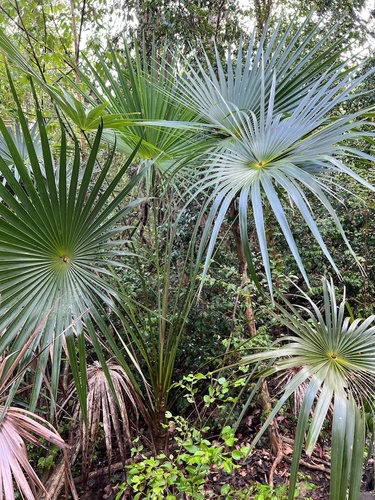
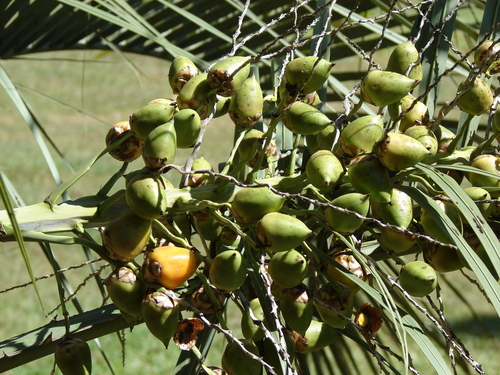
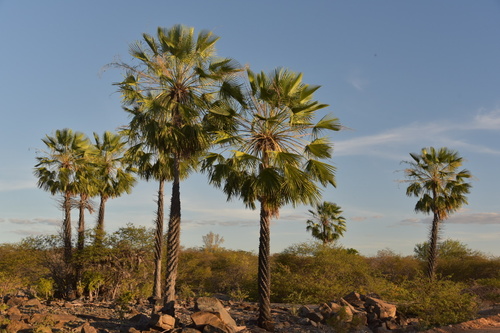
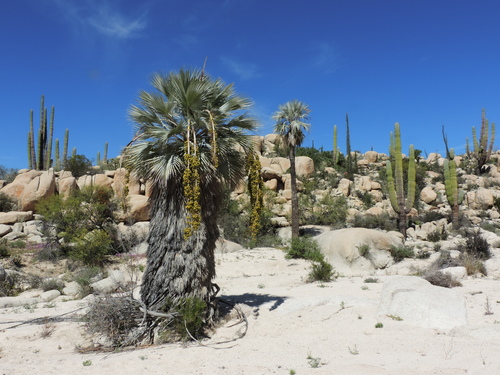
Brahea armata S.Watson, commonly known as the blue fan palm, grows up to 15 metres (49 ft) tall and has a stout trunk. Its distinctly bluish leaves are 1–2 metres (3 ft 3 in – 6 ft 7 in) wide, with 1-metre (3 ft 3 in) long petioles. In wild populations, old leaves remain attached to the trunk, forming a shaggy covering; cultivated plants are typically pruned, with old leaves burned or cut away. Its inflorescences extend beyond the leaf crown and can reach 5 metres (16 ft) in length. The small flowers bloom in February and March, and the fruits are 18–24 millimetres (0.71–0.94 in) long, brown, and generally ovoid to globose in shape.
This species is endemic to the Mexican state of Baja California. Its range extends from just 8 miles south of the Mexico-United States international border near the Jacumba Mountains, into central Baja California desert, and to Isla Angel de la Guarda. Plants growing in the Sierra de San Francisco in Baja California Sur may belong to a different species. It is locally common in arroyos and canyon bottoms, and has also been recorded growing in rock crevices at higher elevations. It sometimes grows alongside Washingtonia filifera var. filifera or Washingtonia filifera var. robusta.
Brahea armata has an attractive appearance, especially when young, and is commonly sold at nurseries in the American southwest and other warm temperate regions around the world. In the United Kingdom, it has received the Royal Horticultural Society's Award of Garden Merit. It is drought tolerant, though occasional deep irrigation is recommended, can grow in both partial shade and full sun, and can tolerate temperatures as low as −10 °C (14 °F). It is sold under many common names, including "Mexican blue palm", "blue hesper palm", "big blue hesper palm", "blue fan palm", "sweet brahea", and "palma blanca". The Cocopah people traditionally eat its seeds after roasting them.