About Bradypus variegatus Schinz, 1825
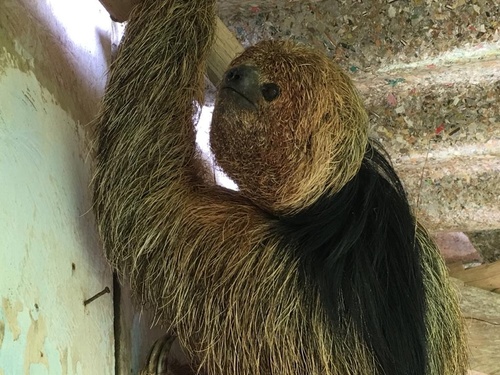
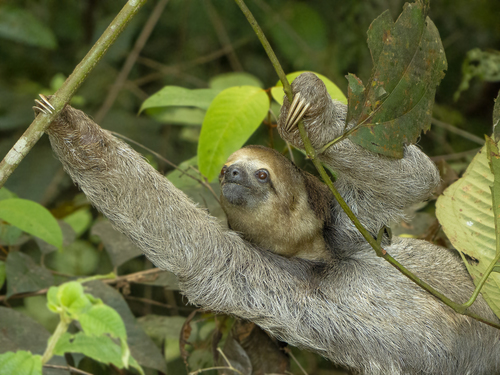
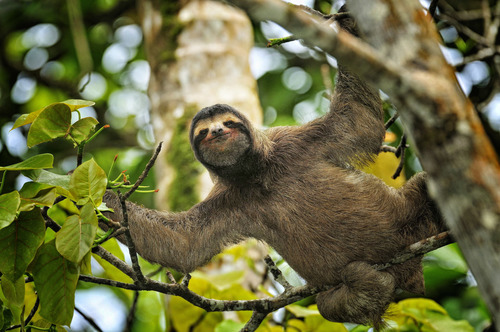
The brown-throated sloth (Bradypus variegatus Schinz, 1825) matches the size and build of most other three-toed sloth species. Both males and females measure 42 to 80 cm (17 to 31 in) in total body length, with a relatively short tail that measures only 2.5 to 9 cm (1.0 to 3.5 in) long. Adult brown-throated sloths weigh 2.25 to 6.3 kg (5.0 to 13.9 lb), and there is no significant size difference between males and females. Each foot has three toes, each tipped with a long, curved claw. Forefoot claws are 7 to 8 cm (2.8 to 3.1 in) long, while hind foot claws are 5 to 5.5 cm (2.0 to 2.2 in) long. The species has a rounded head, a blunt nose, and inconspicuous ears. Like other sloths, brown-throated sloths have no incisor or canine teeth, and their cheek teeth are simple and peg-shaped. They also lack a gall bladder, cecum, and appendix. Brown-throated sloths have grayish-brown to beige body fur, with darker brown fur on the throat, sides of the face, and forehead. The face is generally paler, with a very dark fur stripe running beneath the eyes. Coarse, stiff guard hairs overlay a much softer, dense under-fur. Their hairs are unusual because they lack a central medulla and have numerous microscopic cracks across their surfaces. These cracks host several commensal algae species, including Rufusia pillicola, Dictyococcus bradypodis, and Chlorococcum choloepodis. Algae are generally absent from the hair of young sloths, and may also be absent in particularly old individuals that have lost the outer hair cuticle. Sloth hair also hosts a diverse community of fungi. Certain fungal strains that grow on brown-throated sloth fur have been found to have anti-parasitic, anti-cancer, and anti-bacterial properties. Across parts of its range, the brown-throated sloth shares territory with Hoffmann's two-toed sloth. Where their ranges overlap, the brown-throated three-toed sloth tends to be smaller and more abundant than its relative, and is more active moving through the forest, with more diurnal activity patterns. The brown-throated sloth is the most widespread and common of all three-toed sloths. It occurs from Honduras in the north, through Nicaragua, Costa Rica, and Panama, extending south into Venezuela, Colombia, Ecuador, Bolivia, Brazil, and eastern Peru. It is probably not found immediately north of the Amazon rainforest or east of the Rio Negro, though past confusion about its range occurred because it closely resembles the pale-throated sloth that lives in these regions. It can be found in a wide variety of environments, including evergreen forests, dry forests, and highly disturbed natural areas. It most often occurs from sea level up to 1,200 m (3,900 ft), though individual sloths have been recorded at much higher elevations. Brown-throated sloths have a polygynous mating system. In at least the northern parts of the species' range, mating is most common between January and March, though this timing may differ in other regions. Gestation lasts at least seven months, and a single young is born fully furred and with fully developed claws. Young sloths cling to their mother's underside for five months or more, despite being fully weaned by just four to five weeks after birth. Female brown-throated sloths do not store large amounts of milk in their mammary glands like most other mammals, since infant sloths stay attached to the nipple at all times and consume milk as soon as it is produced. Young sloths begin eating solid food as early as four days after birth, starting by licking food particles from their mother's mouth. This process appears to help them quickly identify edible leaves, and young sloths typically share their mother's preferences for specific leaf types. In the wild, adult brown-throated sloths usually live between 30 and 40 years.