About Bradypodion pumilum (Gmelin, 1789)
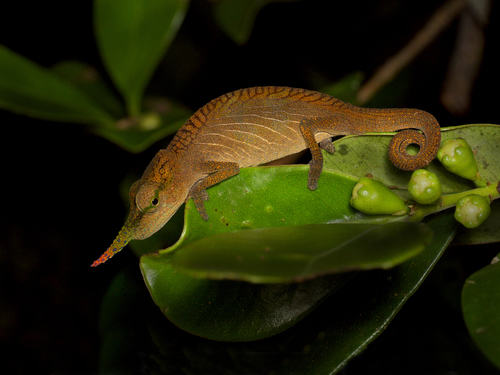
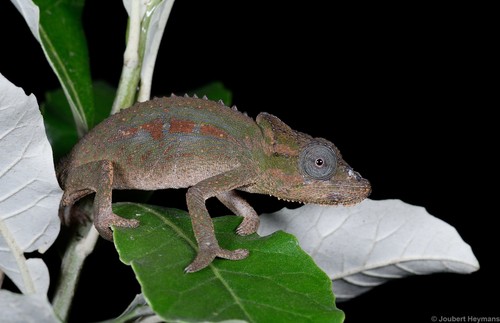
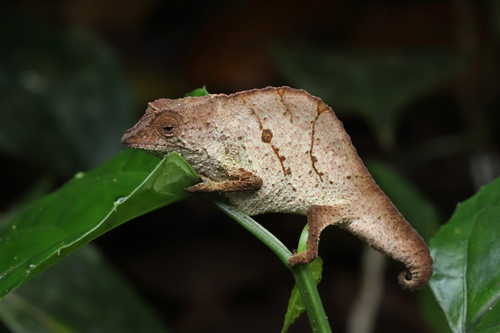
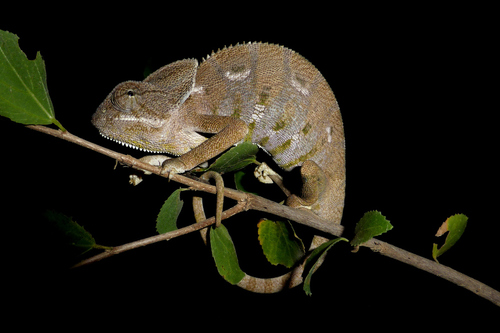
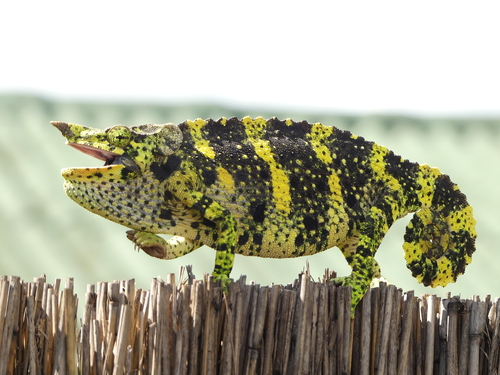
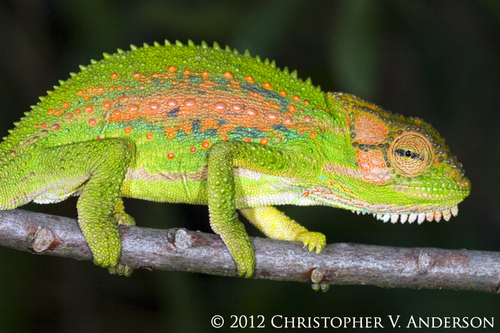
Bradypodion pumilum, commonly called the Cape dwarf chameleon, grows to over 15 cm (5.9 in) in total length including the tail, with males and females reaching similar adult sizes. It is classified as a medium-sized chameleon, with an average adult body size (excluding tail) of 50–70 mm. This species is ovoviviparous; controlled captive observations show the very soft egg-like membrane surrounding each newborn is discarded immediately after birth. Newborns are miniature versions of adults with muted colouration, and typically measure no more than 2 cm in length at birth. Adult Cape dwarf chameleons vary considerably in colour variety, saturation, and pattern, with some individuals appearing far more vibrant than others. Like most chameleons, they have a prehensile tail and feet adapted for grasping twigs, with tiny claws at the end that improve grip. They are normally very slow-moving, and have a characteristic shaking movement that may make them resemble leaves to both prey and predators. When provoked, they can move at speeds of several centimetres per second; when provoked further, they may inflate their bodies, hiss, change colour dramatically, and bite. They do not have sharp teeth, so bites rarely cause more than a slight pinch. Males and females are difficult to tell apart, but males tend to have brighter colours, slightly larger head crests, and a slightly narrower stomach area around the hips. This species has a restricted range within winter rainfall regions of southwestern South Africa, and is specifically limited to the area around Cape Town, the Boland, and the mountainous coastline as far as Agulhas. It is viviparous, meaning it gives birth to live young instead of laying eggs, and can produce one to several clutches of around 10 to 15 offspring each year. Neonate mortality rates are expected to be high due to the species' intense reproductive schedule and high fecundity. Different populations of Cape dwarf chameleon show differing preferences for perch diameter. The two main studied populations, from Kogelberg and Stellenbosch, differ in this behaviour: Kogelberg individuals tend to use perches that are on average significantly wider than those used by individuals from the Stellenbosch site, which select perches at random. Hand size has a direct correlation with grip strength on both broad and narrow rod-like dowels in both populations, and longer tail length corresponds to greater strength. This species prefers to sleep on perches with diameters that match its own morphology. Individuals from habitats with wider perches are also stronger than conspecifics from habitats with narrower branches, a pattern that has led to sexual selection for traits like larger hand size and longer tail length. Bradypodion pumilum has two distinct ecomorphs: a large, brightly coloured, ornate form most often found in closed habitats, and a small, dull form with reduced ornamentation most often found in open vegetation. Casque size is used to communicate fighting ability, but it is not yet known if this size is an honest signal or if it is related to bite force. Bite force is significantly correlated with head size, and head width is the best predictor of bite force strength. Males from open habitats tend to have larger heads and therefore stronger bite force. Larger Cape dwarf chameleons have a high casque (parietal crest) and are brightly coloured with pink patches on their flank. Smaller individuals from open habitats have reduced casques and completely lack flank colour patches. Battles between males can result in severe injuries from biting. Like many other reptiles, Cape dwarf chameleons are poikilotherms, meaning their body temperature depends entirely on environmental temperature. Many lizard species are expected to be affected by climate change in the near future, particularly in Southern Africa where this species occurs. If temperatures rise by 1–3 degrees Celsius, Cape dwarf chameleon running speed is expected to increase. While increased speed may be beneficial, bite force and grip strength would become worse under these conditions. Cape dwarf chameleons are adapted to current habitat temperatures and conditions, but warmer temperatures would actually benefit some of their traits and abilities, indicating the species is very likely to persist into the future even as global warming progresses. This species inhabits a range of different habitats and vegetation types, including fynbos, renosterveld, indigenous Afrotemperate forest, and wetlands. It is less common in extremely fire-prone, low-growing fynbos, and in open sandy or rocky areas. It is most often found in sheltered areas such as river valleys that receive some protection from the region's seasonal fires and support the growth of denser vegetation. It prefers to reside on specific plant species, and particularly favours Restios. This adaptable species has diversified into different forms and colours based on its habitat: individuals living in open, low-lying fynbos vegetation tend to be smaller and dull-coloured with smaller crests, while those in denser, closed vegetation tend to be larger and brightly coloured, with longer tails and larger casques. In the wild, its main predators are snakes and predatory birds such as fiscal shrikes. In open habitats, smaller body size is favoured in Cape dwarf chameleons. Chameleons from different habitats have consistent differences in traits including limbs, feet, tail, and head width. Individuals from open habitats commonly have longer limbs but smaller feet than those from closed habitats. Smaller feet in open habitats are better suited to grasping narrower branches. Natural and sexual selection act with different intensities in open versus closed habitats, which directly shapes the morphological variation seen within this species. The Cape dwarf chameleon is currently experiencing habitat loss and fragmentation of its natural habitat driven by urbanization and agriculture. The species' historical range has become severely fragmented in recent years due to intense urbanization and agricultural transformation, and this trend continues: approximately 6.5 square kilometers of undeveloped land is lost to development each year within the Cape Town municipal area. Additional habitat loss is expected due to rapid climate change near Cape Town, where the species is primarily distributed. In urban areas, Cape dwarf chameleons are restricted to planted vegetation (usually non-native species) and patches of highly disturbed habitat. Populations are often found in overgrown exotic vegetation on road verges, abandoned urban land, riverine thickets, or residential areas. Around 40% of the species' total area of occupancy falls within protected areas managed by provincial parks, national parks, or private reserves. Most of the shrubland in these protected areas is fire-prone, and natural fires are known to be harmful to dwarf chameleon populations. Much of the species' former habitat is now covered by suburban development, and this small species has proven partially adaptable to living in suburban gardens, where it can act as a natural form of insect control. Not all suburban gardens are suitable habitat, however. Cape dwarf chameleons can only survive in sunny gardens with plenty of varied bushy vegetation; direct sunlight is a requirement for this cold-blooded species. They also need appropriate vegetation to perch and climb on, that they can easily grasp with their small claws. The most suitable habitats are bushes and small trees with fine foliage or thin twigs for climbing. Favoured local shrub species include Restio reeds, daisy bushes, Leonotis bushes, Cape Honeysuckle, Plumbago, Bitou bushes, and Psoralea pinnata, among many others. Favoured trees are those that provide low, accessible foliage, such as Karee trees, willows, pepper trees, and Virgilia. Unsuitable terrain includes lawns, paved areas, brickwork, and larger trees with trunks too wide for chameleons to climb. Foliage that has been pruned or trimmed, or exposed to insecticides, also typically kills or injures chameleons. Chameleons naturally wander, and in suburbs with smaller gardens, they also avoid properties that are not connected to larger "green corridors" that connect multiple properties.