About Brachyteles hypoxanthus (Kuhl, 1820)
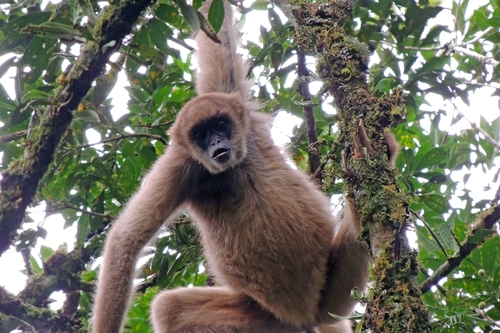
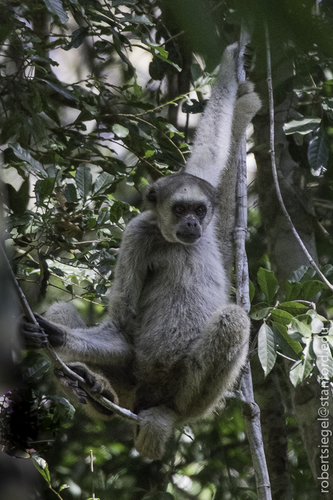
Northern muriquis (scientific name Brachyteles hypoxanthus) have physical traits that let them use all their limbs and tail for traveling and getting food. They spend most of their lives in forest canopies and move via brachiation, using all four limbs and their tail. Adaptive features that help these large atelids include elongated hook-like fingers and shoulders that allow a wide range of movement. Although these monkeys are mainly adapted for arboreal life, they do come down to the ground to drink from water sources, eat soil, or collect ripe fallen fruit. Individual northern muriquis can be distinguished from each other by their natural markings and facial features, including fur color and patterning, ear shape, and face shape and pigmentation. Unlike southern muriquis, northern muriquis do not show sexual dimorphism in canine length. Northern muriquis also retain vestigial thumbs, which are completely absent in their sister southern muriqui species. The reproductive cycle of northern muriquis aligns with seasonal changes in their environment. Infants are usually born during the dry season, so that they can access calorie-dense fruit when high fruit production occurs in the wet season, as they are weaned from their mother's milk. On average, female northern muriquis reach sexual maturity at nine years old. At this age, they may mate with multiple partners to conceive, though females sometimes show preference for certain males. Researchers hypothesize that mating with multiple partners functions to confuse paternity, reduce male aggression, or increase the chance of successful fertilization. The gestation period for northern muriquis is just over seven months. The sex of a newborn northern muriqui can be visually identified within one week of birth, based on the shape and position of its genitalia. No definitive research has established the average lifespan of the northern muriqui, but individual northern muriquis have been documented living past 30 years of age.