About Brachysternus prasinus Guérin-Méneville, 1830
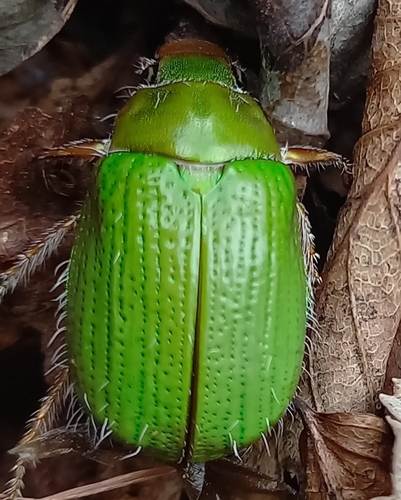
Brachysternus prasinus Guérin-Méneville, 1830 is often confused with the better-known San Juan beetle, Hylamorpha elegans, because both species occupy the same habitat. This species can be distinguished from other members of the Brachysternus genus by two key traits: male B. prasinus have a well-developed supraspiracular ridge on the abdomen, while female B. prasinus have a deeply emarginate terminal sclerite on their legs. Additional identifying features of B. prasinus include a clypeal apex (a structure on the insect's head) that is weakly reflexed at the tip. B. prasinus has prothoracic legs; the femurs of these legs are weakly rounded and dilated, and the tibias bear weak pro tibial notches. Male and female B. prasinus show slight differences in body structure: the apex of the terminal sternite, a segment of the insect's abdomen, is quadrate in males, while in females it ranges from moderately to deeply emarginate, meaning the underside of female B. prasinus is slightly more rounded than that of males. Brachysternus prasinus is distributed along the southwestern coast of South America, occurring in Chile and parts of Argentina. In Chile, its range extends from the Valparaíso region south to Magallanes Province. In Argentina, it is found in Neuquén Province and the Río Grande Department of Tierra del Fuego Province. This species occurs across a broad elevation range, from sea level up to 2,000 meters above sea level. Its geographic range is strongly tied to the availability and distribution of Nothofagus, the plant genus that B. prasinus feeds on. B. prasinus has been recorded in Nothofagus forests near Coquimbo and Llanquihue in Chile, and in the Neuquén and Chubut regions of western Argentina.