About Brachyramphus marmoratus (J.F.Gmelin, 1789)
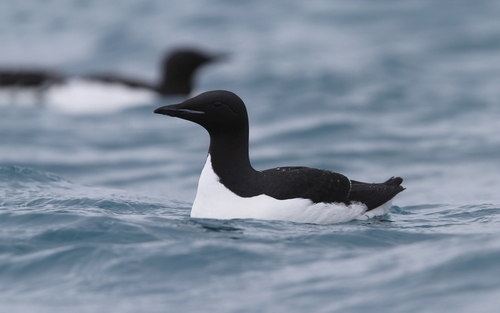
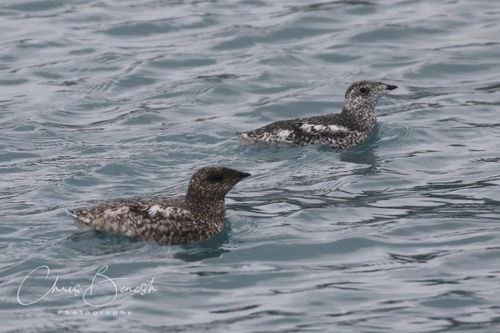
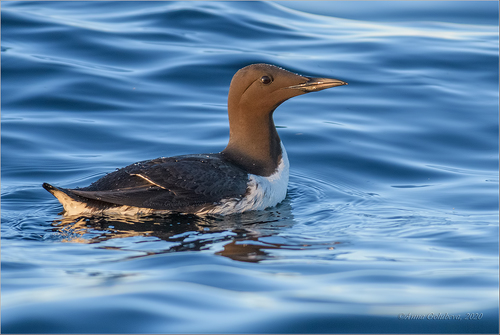
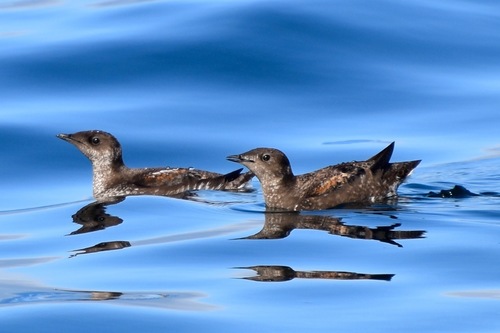
The marbled murrelet, with the scientific name Brachyramphus marmoratus (J.F.Gmelin, 1789), is a small chunky auk measuring around 25 cm in length, with a slender black bill and pointed wings. Its plumage changes with the seasons. Non-breeding plumage typically has white underparts, with black coloring on the crown, nape, wings and back. This species is very similar in appearance to its congener the long-billed murrelet, and the two were considered a single species until 1998. In breeding plumage, both species have brown mottled bodies and faces, but the long-billed murrelet has a pale white throat that the marbled murrelet lacks. In winter plumage, the marbled murrelet has a white neck collar that the long-billed murrelet does not have. The marbled murrelet also has a shorter bill and is slightly smaller than the long-billed murrelet.
In summer, marbled murrelets range from Alaska's Kenai Peninsula, Barren Islands and Aleutian Islands south along the North American coast to Point Sal in Santa Barbara County, south-central California. They mostly winter within the same general area, but usually leave the northernmost parts of their range, particularly areas where fiord surfaces freeze over. They have been recorded as far south as Imperial Beach in San Diego County, California. They are coastal birds that mainly live near saltwater within 2 km (1.2 miles) of shore, but have been found up to 95 km (59 miles) inland in Washington, 56 km (35 miles) inland in Oregon, 37 km (22 miles) inland in northern California, and 18 km (11 miles) inland in central California. Over 90% of all marbled murrelet observations in the northern Washington Cascades fall within 60 km (37 miles) of the coast. In Oregon, they are most often observed within 20 km (12 miles) of the ocean. Many marbled murrelets regularly visit coastal lakes; most lakes they use are within 20 km (12 miles) of the ocean, but a few birds have been found at lakes as far inland as 75 km (47 miles). All lakes used by marbled murrelets are located within potential nesting habitat.
From southeast Alaska southward, marbled murrelets nest in mature or old-growth forest stands near the coastline. These forests are generally characterized by large trees (more than 80 cm/32 inches diameter at breast height, d.b.h.), a multistoried canopy, moderate to high canopy closure or an open crown canopy, large snags, and numerous downed snags in all decay stages. Marbled murrelets tend to nest in the oldest trees in the stand. In Oregon, forests begin to show old-growth characteristics at 175 to 250 years of age, and moss that marbled murrelets nest on grows on limbs of Douglas-fir that are more than 150 years old. The four tree nests found before 1990 shared three characteristics: they were located in large trees (more than 120 cm/47 inches d.b.h.) with an open crown structure, on a moss-covered limb that was camouflaged, partially shaded, roughly horizontal, and at least 36 cm/14 inches in diameter including moss, and located in the middle or lower part of a live crown. However, Marshall noted that due to their low aerial buoyancy, marbled murrelets often nest high in treetops or on steep slopes, and habitat must be sufficiently open to allow easy flight. All marbled murrelet nests found in Washington, Oregon, and California were located in old-growth trees with d.b.h. ranging from 88 cm (38 inches) to 533 cm (210 inches), with a mean of 203 cm (80 inches). Nests were located high above the ground, had good overhead protection, and allowed easy access to the exterior forest. It was initially thought marbled murrelets might reuse the same nest in successive years, but there has been little evidence to support this. Stand size is also important for nest sites: marbled murrelets more commonly occupy stands larger than 202 hectares (500 acres) than stands smaller than 40 hectares (100 acres), though they may nest in remnant old-growth trees or groves surrounded by younger trees. In California, marbled murrelets are usually absent from stands smaller than 24 hectares (60 acres). In Washington, marbled murrelets are found more often when old-growth and mature forests make up over 30% of the landscape, and fewer are found when clearcut and meadow areas make up more than 25% of the landscape. Offshore concentrations of marbled murrelets are almost always adjacent to onshore old-growth or mature forests, though marbled murrelets may not use the interior of dense stands. In the northern parts of the marbled murrelet's range where large trees are absent, marbled murrelets nest in ground depressions, rock cavities on the ground, or on rock outcrops. Marbled murrelets are both ground and tree nesters in areas where forests meet treeless terrain. In northern regions where coniferous forest nesting sites are unavailable, marbled murrelets occupy alpine or tundra near the ocean. In Washington and Oregon, they commonly nest in stands dominated by Douglas-fir (Pseudotsuga menziesii), and also select stands dominated by mountain hemlock (Tsuga mertensiana), western redcedar (Thuja plicata), and Sitka spruce (Picea sitchensis) for nesting. In California, nests are most often located in stands dominated by redwood (Sequoia sempervirens) with scattered Sitka spruce, western hemlock (Tsuga heterophylla) and Douglas-fir; marbled murrelets also occur in stands dominated by Port-Orford-cedar (Chamaecyparis lawsoniana).
Marbled murrelets forage in near-shore ocean areas and inland saltwater areas such as bays, sounds, and saltwater passageways. Some also forage on inland freshwater lakes, and flocks of 50 or more birds have been observed near freshwater lakes. Subadults stay at sea throughout the summer. Marbled murrelets feed within 500 m (1,640 feet) of shore. Winter habitat of the marbled murrelet is the same as its nesting and foraging habitat. During winter, marbled murrelets use inland old-growth or mature sites for roosting, courtship, and investigating nest sites. The use of inland lakes during the nonbreeding season occurs alongside visits to nesting areas.
The marbled murrelet feeds at sea in both pelagic offshore areas (often associating with upwellings) and inshore in protected bays and fiords. The species has never been recorded wandering beyond the Pacific coast of North America; all inland and eastern Brachyramphus records belong to the closely related long-billed murrelet. They feed below the water surface on small fish and invertebrates. Principal foods include sand lance (Ammodytes hexapterus), Pacific herring (Clupea haringus), capelin (Mallotus villosus), shiner perch, and the invertebrates Euphausia pacifica and Thysanoessa spinifera. They often forage in pairs, and do not feed in large flocks like other alcids, though loose aggregations of 500 or more birds occasionally occur in winter. Subadults feed singly; but in early July, when adult pairs are still feeding young, mixed flocks begin to form. Marbled murrelets feed during both the day and night.