About Brachynotus sexdentatus (Risso, 1827)
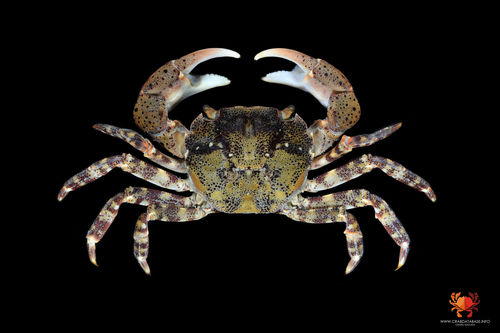
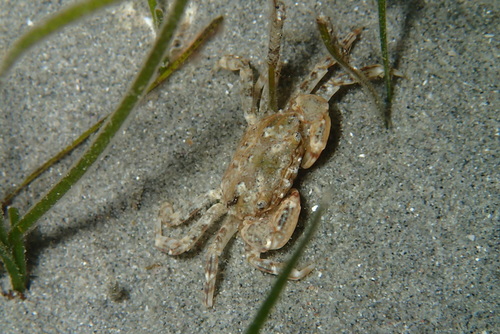
Brachynotus sexdentatus (Risso, 1827) is a small crab species. It reaches a maximum carapace width of 18 millimetres (0.71 in), and most individuals are smaller than 10 mm (0.39 in). The front of its carapace has two lobes, and there are three lateral teeth on each side, each ending in a sharp point. The entire body is olive green with black speckling; legs are slightly paler or greyer. Claws are similar in size on either side of the body, but are much larger in males than in females.
Brachynotus sexdentatus is native to the Mediterranean Sea, ranging from Spain to Israel, and the Black Sea coasts of Romania and Turkey. It is also present in the Suez Canal, having entered the canal's northern end before 1927. In 1957, the species was discovered in Queen's Dock, Swansea, where it was likely introduced via shipping from the Mediterranean. This dock was artificially warmed by the adjacent Tir John coal-fired power station, which drew cooling seawater from King's Dock and expelled the warmed water into Queen's Dock. After the power station closed in 1976, waste heat input to Queen's Dock stopped, and the B. sexdentatus population died out shortly after.
This crab lives in shallow water with muddy substrates, found at depths of up to 90 metres (300 ft). Its eggs are 0.25–0.30 mm (0.010–0.012 in) in diameter and dark brown in colour, and are produced between February and October. After hatching, larvae go through five zoeal stages, instars that use thoracic appendages for movement. At a temperature of 23 °C (73 °F), this development takes at least 12 days. During this period, larvae grow from around 1.35 millimetres (0.053 in), measured from the tip of the rostrum to the tip of the dorsal spine, to 3.35 mm (0.132 in) total length, with a 1.17 mm (0.046 in) carapace length. After five more days, larvae moult into the megalopa phase, an instar that uses abdominal appendages for movement. After another five days, they moult into the first crab-like phase, with a carapace length of approximately 1.55 mm (0.061 in).