About Brachygastra lecheguana (Latreille, 1824)
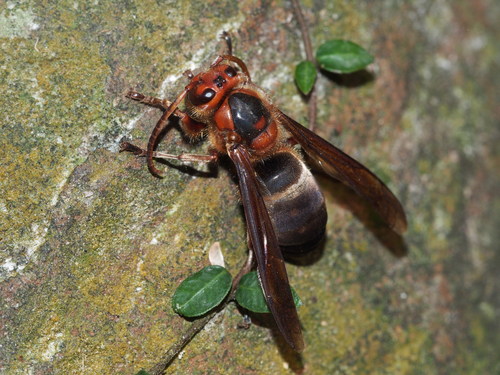
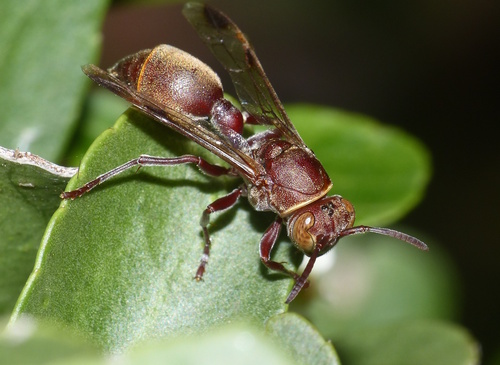
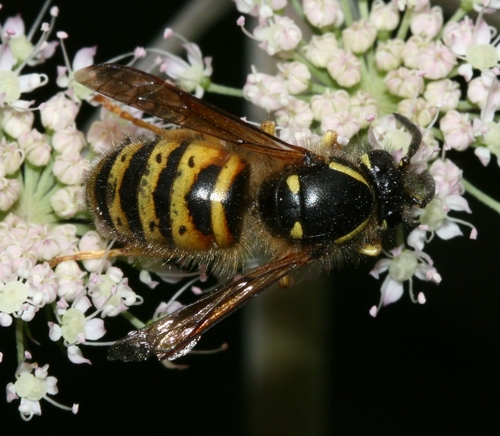
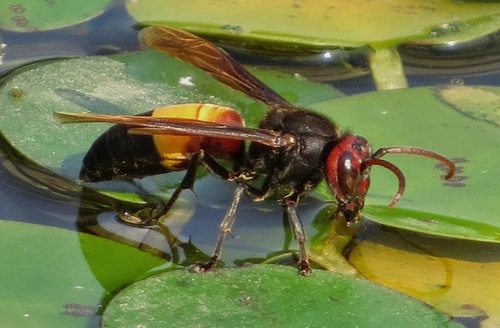
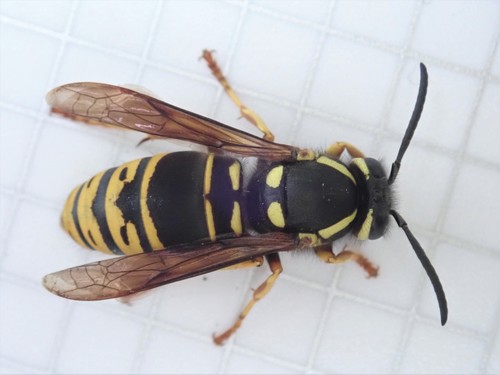
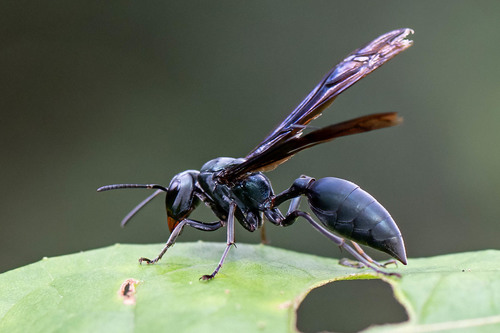
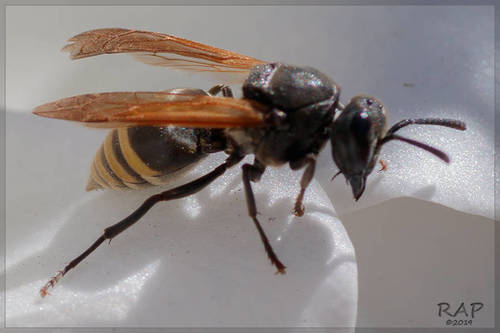
Bequaert has provided a detailed anatomical and feature description for Brachygastra lecheguana. This wasp species is primarily black, with yellow stripes on its abdomen, and also has yellow patches on its thorax and head. Its abdomen is wide and truncate. Queens and workers measure approximately 7.5 to 9 millimeters in length, while males range from approximately 7.5 to 8 millimeters in length. B. lecheguana can be distinguished from B. mellifica by the male reproductive anatomy: males of B. lecheguana have an apically wide digitus, while the digitus of B. mellifica males is relatively narrow. B. lecheguana occurs across North and South America, with a range extending from Mexico to Argentina. It has been observed a small number of times as far north as Texas and Arizona in the United States, but is generally rare in regions north of Mexico. Its nests are globular to oval, made of a gray, paper-like material, typically about the size of a human head, positioned close to the ground, and located in undergrowth. Bequaert included a lengthy description of B. lecheguana nest construction in his 1932 publication on Polybiinae wasps. This wasp tends to prefer open, less humid temperate grassland environments. While B. lecheguana visits a wide variety of flowering plants, it has only been documented as a pollinator in a small number of cases. It is a confirmed pollinator of Baccharis species. As an introduced alien species to the Galápagos Islands, it is recorded as an important pollinator on the island of Santa Cruz. Ethnoentomologists and anthropologists have documented medicinal use of B. lecheguana by certain human communities. Some communities consume both this wasp’s honey and larvae, while others use the adult wasps themselves. In the Pankararé and Matinha communities of Brazil, the honey is used to treat coughing and asthma. In the Serrinha area, the adult wasp is used to treat pain caused by its own sting.