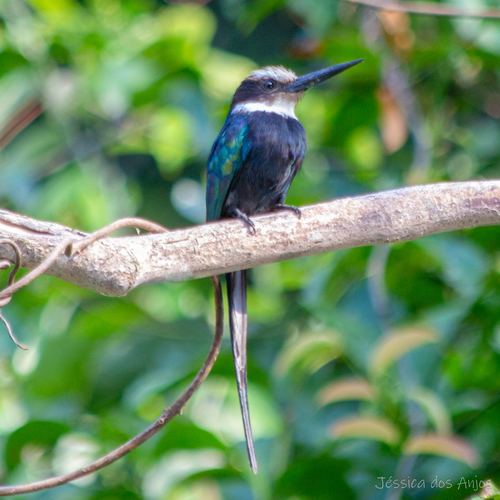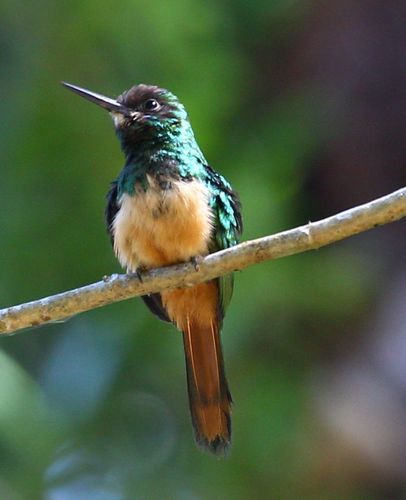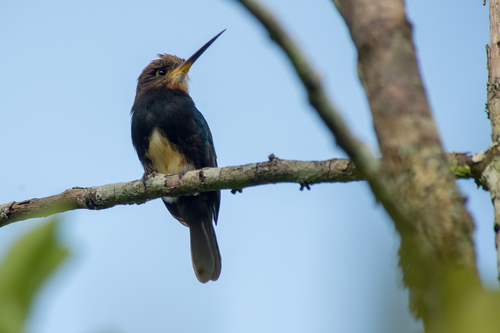
About Brachygalba lugubris (Swainson, 1838)
The brown jacamar, Brachygalba lugubris, is 14 to 18 cm (5.5 to 7.1 in) long and weighs 16 to 23 g (0.56 to 0.81 oz). For the nominate subspecies, the upperparts are brown, the lower back is dark brown with a greenish black gloss, and the wings are blackish with a blue sheen. The chin and throat are off-white, the breast and flanks are reddish brown, and the lower breast and belly are off-white or buff. Other subspecies differ in the tone and intensity of their back and breast colors. The brown jacamar occurs in three separate regions across northern South America, east of the Andes. Its recognized subspecies have distinct ranges: B. l. fulviventris is found in the Meta and Boyacá Departments of central Colombia; B. l. caquetae ranges from Colombia's Caquetá Department south to eastern Ecuador and northern Peru; B. l. lugubris is found in eastern and southern Venezuela, extending east through the Guianas and into northern Brazil; B. l. obscuriceps occurs in southern Venezuela and adjacent northwestern Brazil; B. l. naumburgae is limited to the Maranhão and Piauí states of northeastern Brazil; B. l. phaeonota is found along the Rio Solimões (upper Amazon River) in western Amazonas state, Brazil; B. l. melanosterna occurs in Bolivia's Santa Cruz Department, and in central and southern Brazil. The brown jacamar primarily inhabits primary and secondary terra firme, várzea, and gallery forests. Within these forests, it occurs in the canopy, along forest edges, and in shrubby clearings. It can also be found along watercourses in savanna, and in some parts of its range, on white sand soils. It usually occurs from lowlands up to 900 m (3,000 ft) in elevation, but has been recorded as high as 1,500 m (4,900 ft) in Venezuela.