About Brachydesmus superus Latzel, 1884
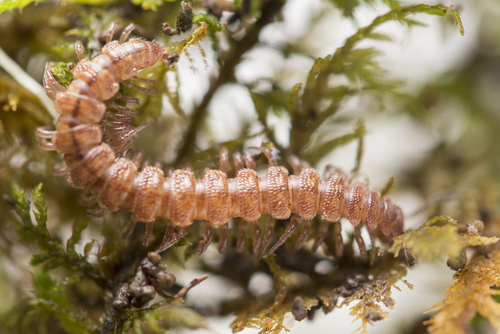
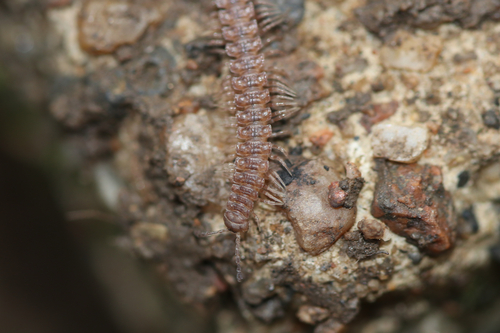
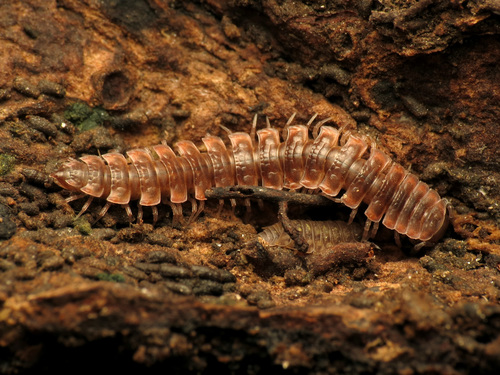
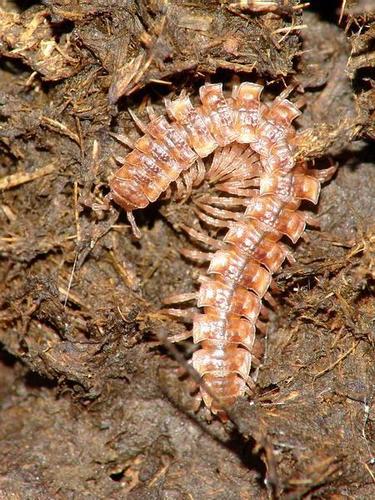
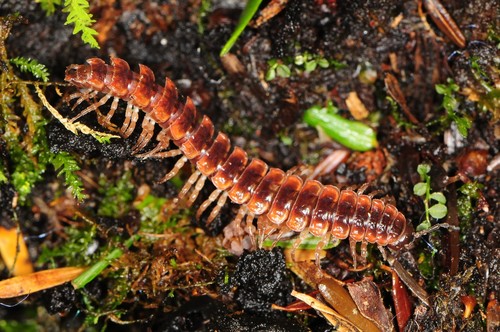
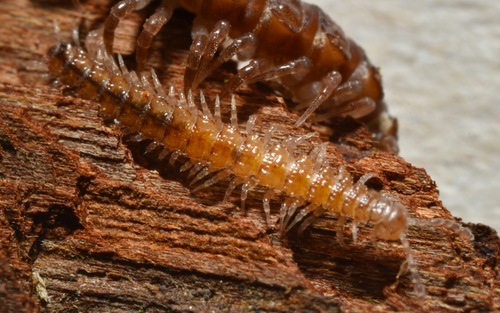
Brachydesmus superus Latzel, 1884 is a millipede species that ranges in color from nearly white to light brown. The body color of live individuals partially depends on intestinal contents that are visible through their transparent cuticle. Adults of this species measure between 6.5 mm and 10 mm in total length, with a body width at the midsection ranging from 0.8 mm to 1.2 mm. Unlike most adult millipedes in the family Polydesmidae, which typically have 20 body segments, adult B. superus have 19 segments when counting the collum as the first segment and the telson as the last. As a result, adult B. superus have two fewer leg pairs than most adult polydesmids: females have 29 leg pairs, while males have 28 pairs of walking legs. This count excludes the eighth leg pair in males, which is modified into a pair of gonopods. The male gonopods sit close to the ventral surface between the preceding leg pair. Each gonopod is slender, slightly curved, and tapers toward its distal end. It has several teeth or spines on its concave side, plus a prominent hairy tubercle near the distal end. Male walking legs are also thicker than the legs of females. Adult females have epigynal flanges: a pair of raised ridges running along the anterior margin of the ventral surface of the third body segment. The head of B. superus is broader than the collum, but not broader than the second body segment. Body segments increase in width up to the fifth segment, then begin to taper toward the telson after segment 15 or 16. On anterior segments up to segment 6, the posterior corners of the paranota are obtuse angles. From segment 6 onward these corners become pointed, and starting at segment 11 or 12 they grow increasingly acute and extend behind the posterior tergal margin. The body surface is especially shiny. Tergal setae are relatively long, and most end in sharp points. This millipede has been recorded across most of Europe, and has been introduced to northeastern United States, Canada, Cape Verde, Madeira, the Azores, the Canary Islands, and the Juan Fernández Islands in the Pacific Ocean. It is common in the British Isles, where it is one of the most frequently recorded millipede species. In North America, its range extends from Michigan and Ontario to North Carolina. B. superus is an annual species: individuals reach maturity in spring, and die after mating and laying eggs. In the British Isles, for example, adults are abundant from March to June, but scarce in August and September. Females usually lay around 50 eggs in spring or summer inside an elaborate dome-shaped nest, then die, and only rarely produce a second nest. Juveniles hatch within one to six weeks, at the first developmental stage with only seven body segments and three leg pairs. Most polydesmid millipedes go through eight developmental stages of teloanamorphosis to reach maturity. B. superus completes the first seven of these stages, but reaches maturity one molt earlier, at the seventh stage rather than the eighth, then mates and dies without molting again. This gives adult B. superus fewer body segments and legs than most other adult polydesmids. The species takes five to nine months to reach maturity. In Wales, for example, first instars appear by July, most reach the third developmental stage by late autumn, continue developing through the winter, and reach the fifth and sixth stages by the following spring.