About Brachychiton megaphyllus Guymer
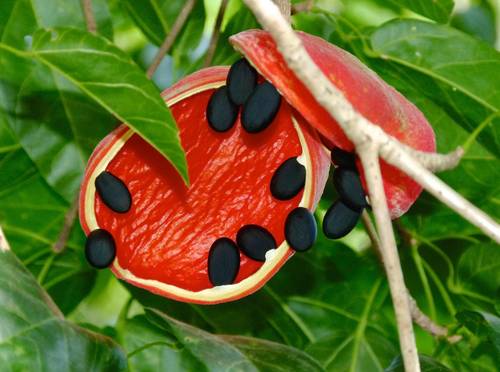
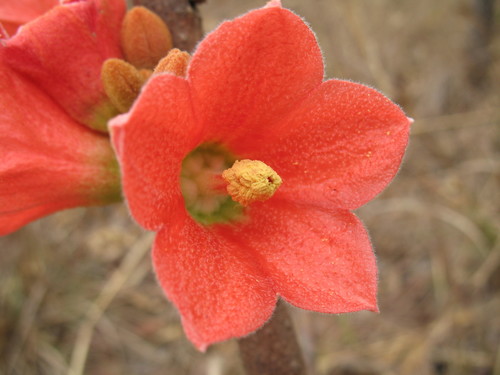
Brachychiton megaphyllus, formally described by Guymer, grows as a large shrub or small tree, reaching 2 to 8 metres (6 feet 7 inches to 26 feet 3 inches) in height. Its trunk measures 10 to 25 centimetres (3.9 to 9.8 inches) in diameter at breast height, and is covered in dark brown bark marked with vertical furrows and shallow tessellations. Like all species in the Brachychiton genus, its leaves are alternately arranged along stems. The plant produces large leaves that are roughly oval or three-lobed, 15 to 26 centimetres (5.9 to 10.2 inches) long and 13 to 24 centimetres (5.1 to 9.4 inches) wide, with a heart-shaped (cordate) base. It is deciduous, and loses all leaves from June to September. Its orange-red flowers bloom between June and October, and sometimes into November. Its yellow-brown, woody seedpods, called follicles, mature from September to June. These seedpods are 6.5 to 11 centimetres (2.6 to 4.3 inches) long and 3 to 4.8 centimetres (1.2 to 1.9 inches) wide, and split along their length to hold 25 to 45 seeds. The seeds are ovoid, smooth-surfaced, 8 to 9 millimetres (0.31 to 0.35 inches) long and 6 to 7 millimetres (0.24 to 0.28 inches) wide, and covered in a hairy coating called the exotesta. This species is native to the Northern Territory of Australia, found north of 17° S latitude. It grows as part of open eucalypt woodland, and is commonly associated with Eucalyptus miniata and Eucalyptus tetrodonta. It typically grows on red soils formed from laterite. It is commonly cultivated within the Northern Territory, and was named the official city emblem of Darwin in 1988. Local Aboriginal communities have documented multiple uses for this species. Women from Arnhem Land communities Yirrkala, Maningrida, and Gapiwiyak spin thread from its bark to make necklaces and bracelets. The rootstock of young Brachychiton megaphyllus can be eaten raw. Bark fibre is used to make rope and string. Stems produce an exuded gum that is eaten, and can also be used as a binder for paint. The seeds can be eaten either raw or roasted. Speakers of the Ngan’gityemerri language recognize that flowering of B. megaphyllus indicates the season when freshwater crocodiles lay eggs.