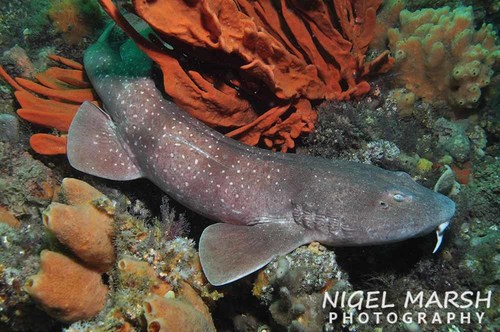
About Brachaelurus waddi (Bloch & Schneider, 1801)
Scientific name: Brachaelurus waddi (Bloch & Schneider, 1801). Description: The blind shark has a stocky body and a wide, somewhat flattened head with a blunt snout. Its small, oval eyes are set high on the head and have strong ridges underneath. Oval spiracles are positioned behind and below the eyes, and have obvious raised rims. The nostrils sit almost at the tip of the snout, with long, tapering barbels at the front, plus well-developed skin flaps and grooves around the incurrent openings. A pair of distinct grooves connect the nostrils to the small, almost transverse mouth. There are 32–34 upper tooth rows and 21–29 lower tooth rows; each tooth has an upright, awl-shaped central cusp and a pair of small lateral cusplets. The five pairs of gill slits are small, with the fifth pair located close to the fourth. Pectoral fins are large and broad, with rounded edges. The two dorsal fins are roughly equal in size, with rounded tips and angular free rear edges; the first dorsal fin starts over the bases of the pelvic fins. Pelvic fins are rounded and almost as large as the pectoral fins. The anal fin is less than half the size of the dorsal fins and sits very close to the base of the long, low caudal fin. The caudal fin makes up about a quarter of the shark’s total length, has no ventral lobe, and features a strong ventral notch near the tip of the upper lobe. Large dermal denticles give the shark’s skin a rough texture. This species is light to dark brown on its upper side, often marked with white flecks, and is paler underneath. Juveniles also have dark bands across the body and tail that fade as the shark ages. The blind shark can reach a total length of 0.9–1.2 m (3.0–3.9 ft), though most individuals are much smaller. Distribution and habitat: The blind shark’s range is restricted to the eastern coast of Australia, extending from Mooloolaba in southern Queensland to Jervis Bay in New South Wales. Older reports of this species from off Western Australia and the Northern Territory are now considered misidentifications of the brownbanded bamboo shark. It is a bottom-dwelling species that generally lives on the continental shelf, from the intertidal zone (including tidal pools barely deep enough to cover its body) down to a depth of 73 m (240 ft); it has been recorded as deep as 140 m (460 ft). Its preferred habitats are rocky areas and adjacent seagrass beds, and juveniles are common in high-energy surge zones. In Nelson Bay, this shark has been observed lying openly on top of sponges. Biology and ecology: Contrary to its common name, the blind shark has perfectly adequate vision. Anglers gave it this name because the shark retracts its eyeballs and closes its thick lower eyelids when removed from water. This species can survive out of water for up to 18 hours, which lets it withstand being stranded when the tide goes out. The blind shark is secretive and sluggish during the day: adults usually hide in caves or under ledges, while juveniles hide inside crevices, though it will accept food if the opportunity arises. At night, it travels over reefs and seagrass meadows to forage for small invertebrates (including crabs, shrimp, cephalopods, and sea anemones) and bony fishes. It captures prey using suction. The blind shark is aplacental viviparous, and may have an annual reproductive cycle. Females give birth to 7–8 pups during the summer; newborns measure 15–18 cm (5.9–7.1 in) long. Males reach sexual maturity at a length under 62 cm (24 in), and females reach sexual maturity at a length under 66 cm (26 in). It has been recorded living up to 20 years old in captivity. A known parasite of this shark is an undescribed species of tapeworm in the genus Carpobothrium.

