About Brabejum stellatifolium L.
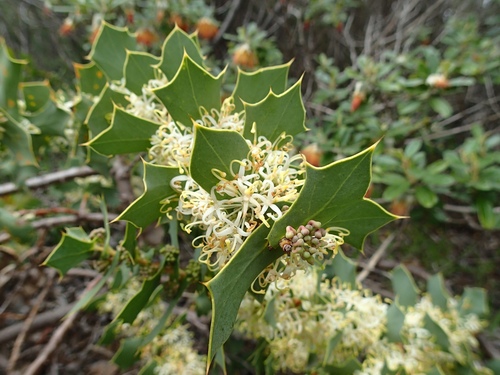
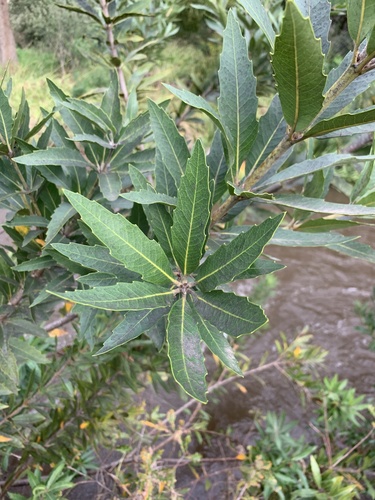
Brabejum is a genus in the family Proteaceae that contains only one species: Brabejum stellatifolium L. This large evergreen tree is commonly known as wild almond, bitter almond, or ghoeboontjie. In the wild, it is restricted to South Africa's Western Cape province, where it grows in thickets along stream banks. It holds botanical interest because it is the only African member of the large grevilleoid subfamily Grevilleoideae. It grows as a bushy small tree, branching widely at ground level and producing numerous vigorous, erect stems. Its leaves can reach up to 15 cm (6 inches) long, are narrow with blunt teeth, grow at intervals along branches, and are most often arranged in whorls of six. In summer, it produces densely clustered white flowers growing on spikes that emerge from rusty buds at the leaf axils. Its fruits, which grow up to 5 cm (2 inches) long and range in color from magenta to reddish brown, resemble almonds and appear in autumn. The nut of this fruit is too bitter to be eaten, but in earlier times people boiled, roasted, and ground it to make a coffee-like drink. This tree has special significance to Cape Town's cultural heritage, as it was used to build Van Riebeeck's Hedge, the Cape's first formal boundary. Portions of this original hedge can still be seen growing at Kirstenbosch today. The natural range of this tree is confined to the fynbos biome of the Cape, South Africa, where it is often a component of local Afro-montane forests. It prefers moist habitats, and is commonly found growing near streams in sheltered gorges and on lower mountain slopes. In Cape Town, it remains abundant on the eastern slopes of Table Mountain, even though large numbers of the trees were once felled here to clear space for commercial pine plantations. Despite its very limited natural range, this species is not currently listed as threatened. The natural occurrence of this tree in South Africa is of considerable interest to biologists, because Brabejum has no close relatives living in Africa. Within the large Proteaceae family, its closest relative is the Macadamia tree native to Australia and New Caledonia. Its more distant relatives are likewise found only in Australasia and South America. In fact, this species is not only the only member of its genus Brabejum, it is also the only member of its subfamily Grevilleoideae found in Africa; the proteas that grow alongside it in South Africa are relatively distant relatives. The ancient Proteaceae family is thought to have originated on Gondwanaland hundreds of millions of years ago. As plate tectonics gradually split the supercontinent apart, different populations of these plants became separated, and their descendants now grow on land fragments separated by thousands of miles of ocean. Brabejum is the lone surviving member of its branch of the Proteaceae family that remains on the African fragment of ancient Gondwanaland.