About Boykinia richardsonii (Hook.) A.Gray
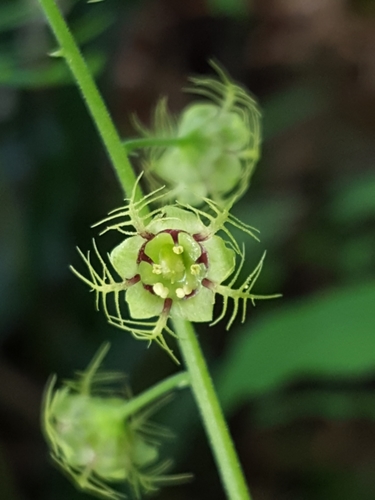
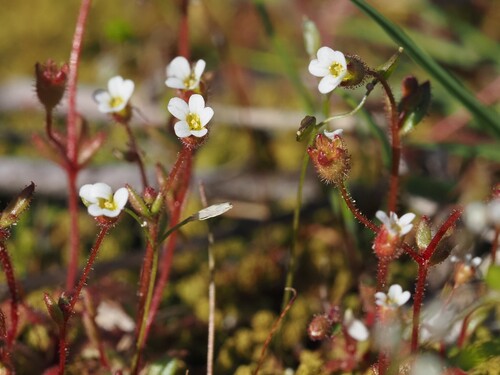
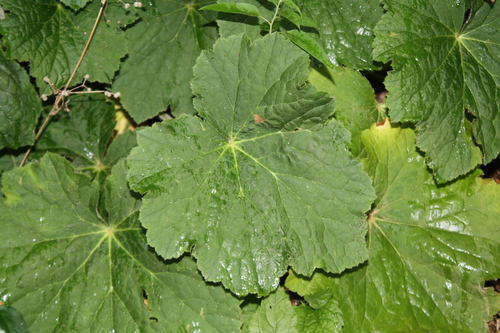
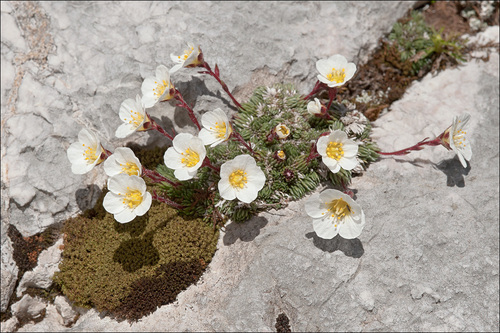
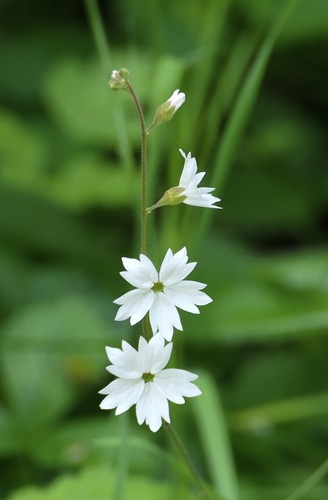
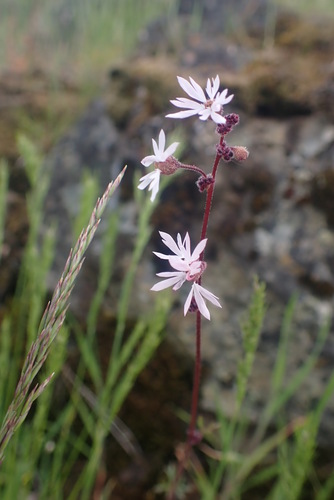
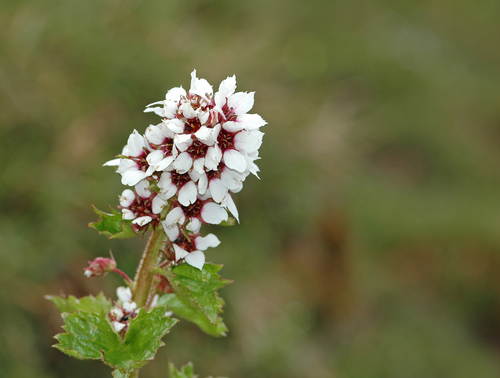
Boykinia richardsonii (Hook.) A.Gray grows from a system of spreading underground dark brown rhizomes. Its upright stems reach 10–60 cm (3.9–23.6 in) in height and are covered in capitate trichomes. Reniform basal leaves measure 2–7 cm long by 5–11 cm wide, typically one and a half times as wide as they are long, and grow from trichome-covered petioles 2.5–10 cm long. Leaves are glandular-pubescent on their lower surface, glabrate on their upper surface, have frequent stomata, are shallowly lobed, and have margins with 2–3 orders of dentation. Stipules are 2–5 millimeters long; they are either a dilation of the petiole base or foliaceous, with smaller stipules fringed with subulate bristles. Cauline leaves are similar to the stipules and fringed with brown hair. The plant's inflorescence is narrowly cylindrical, with three flowers per branch. Its pedicels are densely covered in stipitate-glandular structures. At the end of each pedicel is a 6–14 mm long calyx, divided about halfway along its length into triangular to lanceolate sepals that measure an additional 3–7 mm. The free portion of the hypanthium measures 2–3 mm; its nectary is greenish or purple, and it has an inferior ovary. Petals are white, sometimes with pink veins, ovate, 8–12 mm long by 3–7 mm wide (generally two or three times the length of the sepals), with a cuneate or clawed base. Stamens are 3–5 mm long, generally equal to or slightly shorter than the sepals. Filaments are 2–4 times the length of undehisced anthers. The plant's capsules are ovoid, turbinate or urceolate. Seeds inside the capsules are smooth, brown, 1.3–1.9 mm long. Their testae are often creased or folded, and also covered with tubercles that do not protrude far above the seed coat surface. Delineations of the species' range vary, but most experts agree on a distribution stretching across the Alaska North Slope into the foothills of the Brooks Range, up to elevations of 400 m (1,300 ft). From there it extends across the Canada–United States border through the Arctic National Wildlife Refuge (ANWR) into northern Yukon and Ivvavik National Park, turns south through Vuntut National Park, then bends southwest through the Porcupine River valley to end at the Alaska Range, where it is found as high as 1,700 m (5,600 ft) on the slopes of Denali National Park and Preserve. Some maps show isolated populations on the Seward Peninsula and the Norton Sound coast. Others extend the range along the Arctic coast into the Northwest Territories as far as Coppermine, the area where Richardson's team collected the first identified specimens, or across all of northern Alaska. Two early 20th century expeditions reported collecting specimens east of the Bering Strait, in eastern Siberia. While Eric Hultén could not confirm this presence, he considered it very probable that B. richardsonii occurs there. However, the species is not reported in either of the two most comprehensive Soviet-era plant catalogs, so it is currently believed that these early reports of occurrence in Siberia were mistaken. The Global Biodiversity Information Facility records 17 occurrences in an area of the Swedish Arctic near the Norway border, recorded since 2006. Specimens from different areas of the range have widely varying recorded chromosome counts. A 1968 study of specimens from the Brooks Range found they had 84 chromosomes, a 2n count far above the typical count for the genus. Eight years later, specimens from the Alaska Range were found to have 36 chromosomes. The only morphological difference observed between plants from the two regions is the greater equatorial diameter of pollen grains in Brooks Range samples. Gornall and Bohm concluded that this distinction merits further study if confirmed. They speculated it might correlate with whether plants grow in regions that were glaciated during the last Ice Age, versus regions that remained unglaciated such as ANWR, Ivvavik and Vuntut parks along the northern Alaska-Yukon border. B. richardsonii evolved before the last Ice Age, during the Neogene (Late Tertiary) period 25–10 million years ago. At that time, fossil records from the Seward Peninsula show much of present-day Alaska was heavily forested, dominated by a mix of temperate species like hazelnut and hemlock, and boreal species like larch and spruce. When glaciers advanced, many species native to these forests either migrated south or went extinct. The Beringia refugium, formed in unglaciated areas, allowed B. richardsonii and other forest species to survive in their original range, and the species has remained endemic to this area long after glaciers retreated. With much less forest cover remaining across its range today, B. richardsonii has adapted to grow on mostly treeless tundra, where it flowers during the brief summer months from June to August. It most commonly grows in gullies formed by streams or meltwater between snow patches that linger into early summer. Patches growing in the shade of dwarf shrubs, mostly various Salix species particularly Salix arctica, recall the species' forest origins. In the southern part of its range, it also occurs on the edges of and just outside subalpine forests. Throughout its range, it is a calcicole that prefers soil rich in lime. In the Denali area, B. richardsonii has been observed to be a popular summertime forage food for grizzly bears, so much so that it is known locally as bearflower. A University of Montana graduate student who wrote his master's thesis on grizzly feeding habits on Alaskan Arctic barren ground said this species was by far the bears' most preferred plant, although in some areas bears ignored it in favor of local grasses. A similar study that tracked radiocollared bears around the Firth River valley in Ivvavik National Park, near the northern end of the plant's range, found it was also the most popular plant with bears there. Adolph Murie observed the plant's popularity with grizzlies during his Alaska studies; he once watched a bear spend two hours leisurely consuming B. richardsonii in a large patch. It was more common for bears to eat it as part of a rotation of locally available plants, especially when the rotation included horsetail, another grizzly favorite. Murie noted that flowers seemed to particularly interest bears, often to the exclusion of the rest of the plant, although he once saw a bear discard the flowers and focus on the stems and leaves. In 1963, Murie recalled finding greater than usual evidence of B. richardsonii's popularity with grizzlies. That summer followed a heavier than average winter, and snowbanks lingered later into summer than usual. Berries, which grizzlies usually forage for in late summer as the nutritional content of herbaceous plants declines, were consequently scarce. Late snowmelt also led to more abundant growth of B. richardsonii than usual for August, and Murie saw large patches that had been thoroughly grazed. Scat he analyzed at the time correspondingly contained heavy evidence of B. richardsonii consumption, and one sample he collected around the September equinox that year contained no evidence the bear had eaten any berries, only B. richardsonii — the latest in the year he ever recalled this being the case. Bears are not the only species that consume B. richardsonii. Gornall and Bohm reported seeing some plants with broken open capsules, which suggested to them that birds feed on the seeds.