About Bovista pila Berk. & M.A.Curtis
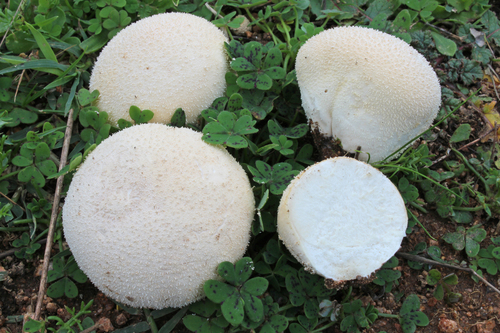
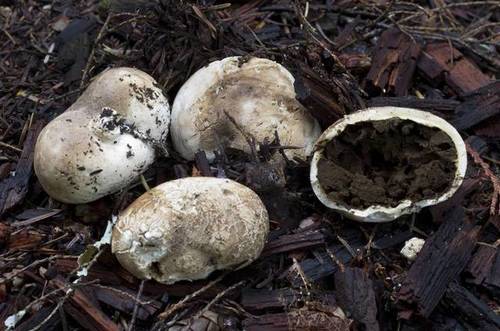
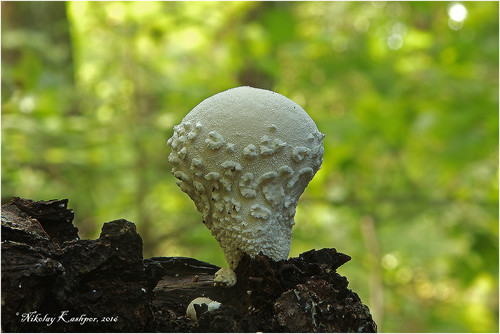
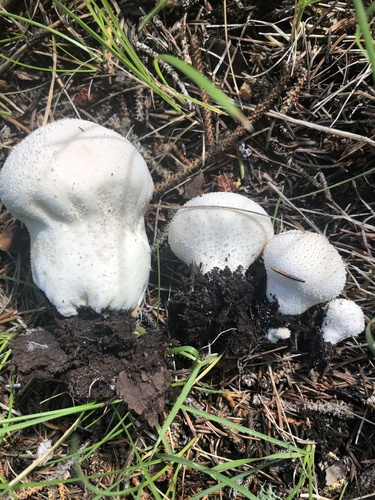
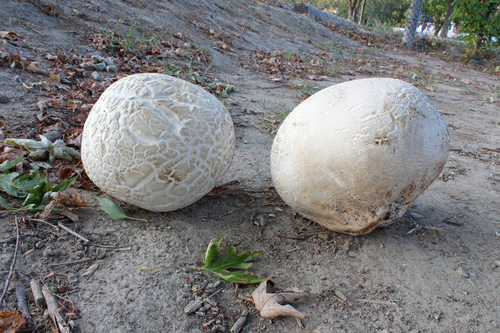
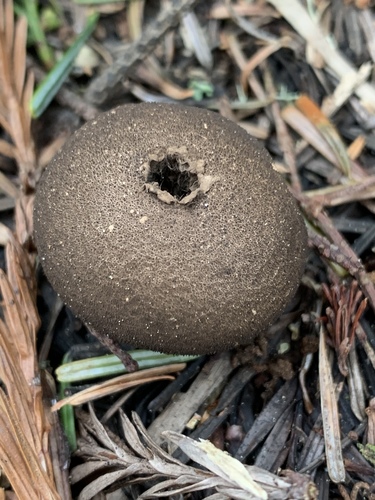
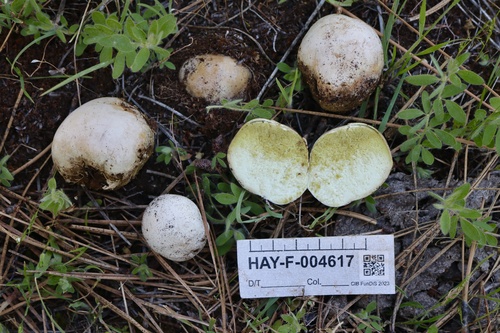
Bovista pila (Berk. & M.A.Curtis) produces egg-shaped to roughly spherical fruit bodies reaching up to 8 cm (3 in) in diameter. It has a thin outer tissue layer called the exoperidium, 0.25 millimeters thick, that is white to slightly pink. Initially, its surface is furfuraceous, meaning it appears covered with tiny bran-like flakes, and it later develops irregular, crooked, rivulose markings. When the puffball matures, the exoperidium flakes away to expose a thin inner peridium, the endoperidium. This shiny inner layer is splotched with darker areas, and its coloration resembles the metallic tones of bronze and copper. Bovista pila puffballs attach to the ground via a small cord called a rhizomorph, which typically breaks off when the puffball reaches maturity. The interior flesh, known as the gleba, is made up of spores and surrounding capillitial tissue. When young, the gleba is white, firm, and contains tiny, irregularly shaped chambers that can be seen with a magnifying glass; as spores mature, the gleba turns greenish, then brown, and becomes powdery. In old age, the upper surface of the puffball cracks and tears open. The resilient texture of the inner peridium allows the puffball to retain its ball shape after detaching from the ground. When detached old puffballs are blown around by wind, spores are shaken out through the open tears. The spores of Bovista pila are spherical, smooth when viewed under a light microscope, measure 3.5–4.5 μm, and have thick walls and very short pedicels. Its spore-bearing cells, basidia, are club-shaped and measure 8–10.5 by 14–18 μm. They are most often four-spored, rarely three-spored, and have sterigmata of unequal lengths ranging between 4 and 7.4 μm. Capillitia, the sterile fibers interspersed among the spores, tend to form loose balls roughly 2 mm in diameter. The main trunk-like branches of the capillitia can reach up to 15 μm in diameter, with walls typically 2–3 μm thick. Bovista pila grows in corrals, stables, roadsides, pastures, open woods, lawns, and parks. Its puffballs fruit singly, scattered, or in groups growing on the ground. Its spore cases are persistent and can survive overwinter, and fruiting occurs throughout the mushroom season. It is widely distributed across North America, including Hawaii. There are very few well-documented records of Bovista pila growing outside of North America. Hanns Kreisel documented the species from Russia, in what is now the Sakha Republic. It has been tentatively identified from the Galápagos Islands, and collected from Pernambuco and São Paulo, Brazil. South American specimens have grayish-yellow gleba, which suggests they are not fully mature, so this identification is tentative, as unripe material may have different microscopic characteristics than mature material. Though the species has been reported from both the European part of Turkey and Anatolia, reports that lack supporting microscopic or macroscopic information are viewed with skepticism. Bovista pila is edible when its interior gleba is still firm and white, and it has a mild taste and odor. The Chippewa people of North America used this puffball as a charm, and used it medicinally as a hemostat. In British Columbia, Canada, livestock farmers in certified organic programs who cannot use conventional drugs use the spore mass of this puffball: it is applied to bleeding nicks from hoof trimming, then wrapped with breathable first-aid tape. It is also used the same way on bleeding areas from disbudding, and on wounds from sternal abscesses.