About Bouteloua curtipendula (Michx.) Torr.
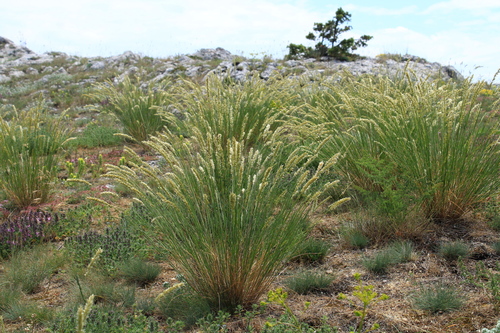
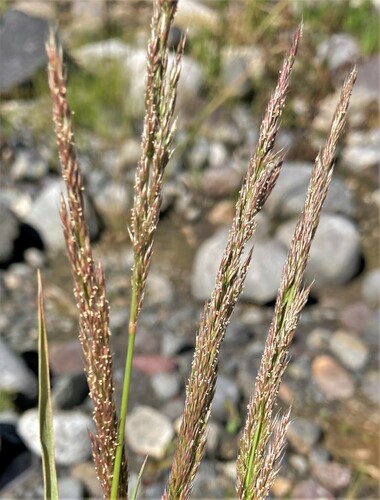
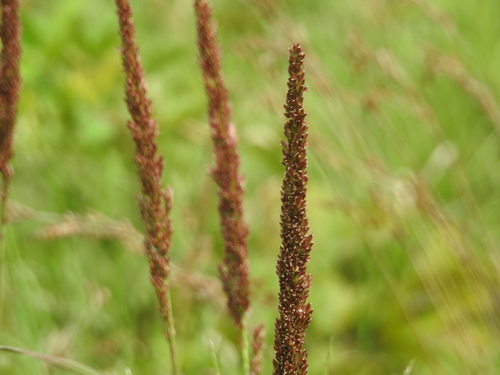
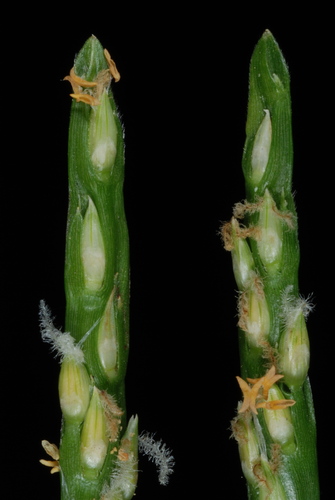
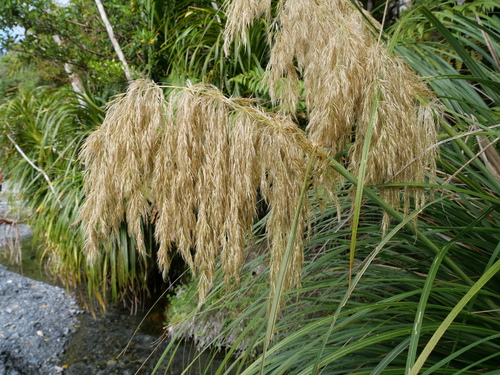
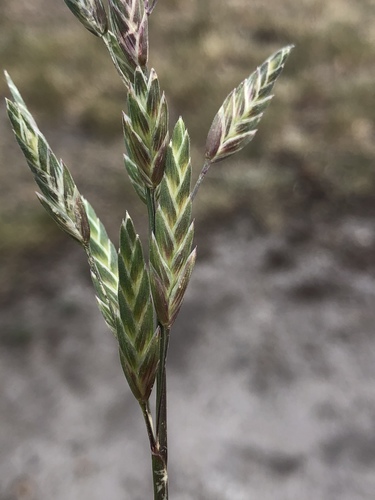
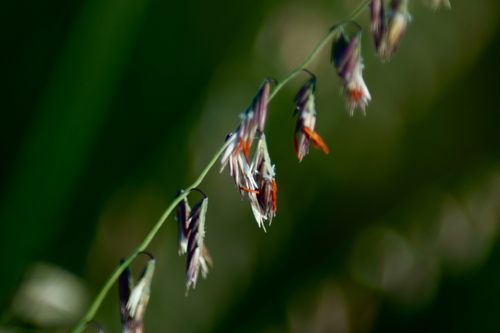
Sideoats grama, scientifically named Bouteloua curtipendula (Michx.) Torr., is a warm-season grass. Its flowering stems, called culms, grow 30–100 cm (12–39 in) tall, and bear alternate leaves that are concentrated near the base of the culm. The leaves range in color from light green to blue-green, and grow up to 6 mm (1⁄4 in) across. Flowers bloom in summer and autumn, arranged as compact spikes that grow alternately along a raceme on the top 15 to 25 cm (6 to 10 in) of the culm. The spikes typically all droop to one side of the stem, which gives the plant its common name. Each culm holds 10 to 50 spikes, and each spike contains between three and six spikelets, rarely up to 10. Individual spikelets are 4.5 to 10 mm (3⁄16 to 13⁄32 in) long, and are made up of two glumes and two florets. One floret is fertile, and bears colorful orange to brownish-red anthers plus feathery white stigmas during blooming; these contrast with the pale green, pale red, greenish-red, or purple color of the spikes themselves. After blooming, the spikes turn straw-colored. Fertile florets produce seeds, and once the seeds are ripe, the entire spikes drop to the ground. Sideoats grama grows well on mountainous plateaus, rocky slopes, and sandy plains. It tolerates both drought and cold, and is hardy in USDA hardiness zones 4–9, which correspond to average annual minimum temperatures between −30 to 25 °F (−34 to −4 °C). Ecologically, it serves as larval food for the veined ctenucha moth (Ctenucha venosa). It is considered a high-quality forage grass for livestock, and is planted to control erosion. It is also cultivated as an ornamental plant for use in native plant gardens and drought-tolerant gardens.