About Botryllus schlosseri (Pallas, 1766)
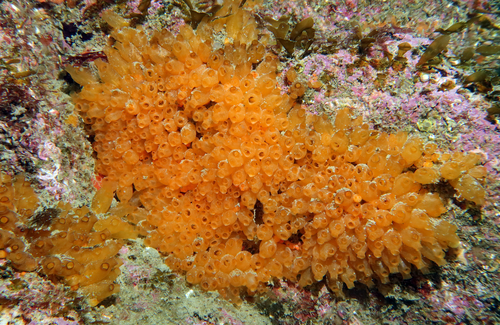
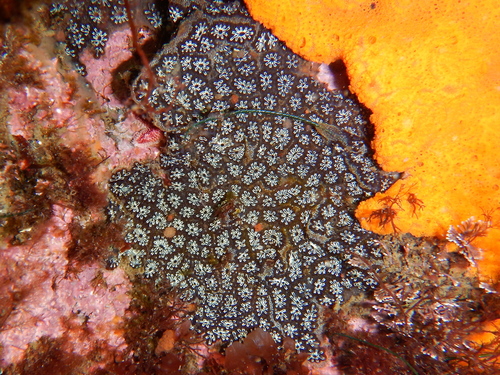
Individual zooids of Botryllus schlosseri can grow up to 3 millimetres (0.12 in) in size, while entire colonies can reach 50 millimetres (2.0 in) in length. This species can be told apart from Botrylloides species by the growth pattern of its zooids: B. schlosseri zooids spread out from a central point in a star-like shape, similar to the arms of a star. Additionally, B. schlosseri colonies typically have fewer zooids per cluster, with 5 to 8 zooids per cluster in this species, compared to 10 or more in Botrylloides. Botryllus schlosseri occurs in many different colors, including orange, blue, and grey. A colony fragment can easily separate from the main colony to grow into an independent colony, which is usually called a subclone. Two separate B. schlosseri colonies can fuse together if they share common alleles for historecognition. The native range of Botryllus schlosseri covers the northeastern Atlantic Ocean, the Mediterranean Sea, and the North Sea. Over the past 100 years, its range has expanded to a nearly global distribution. In the western Atlantic Ocean, it occurs from the Bay of Fundy to North Carolina, where it is considered an invasive species and described as "the most common colonial tunicate in North America."