About Botrychium minganense Vict.
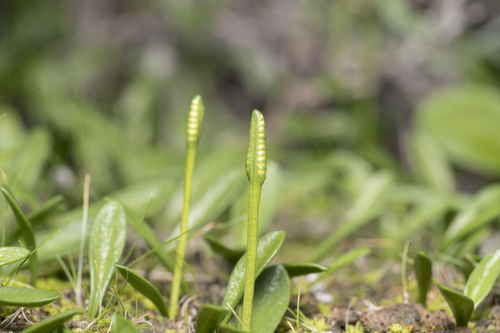
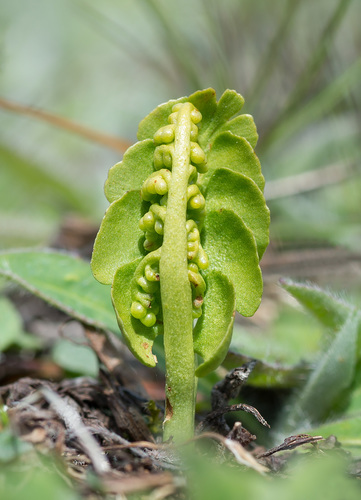
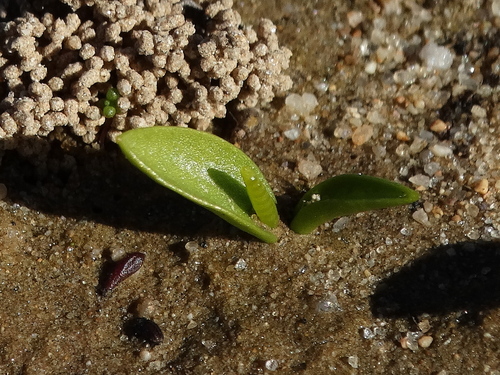
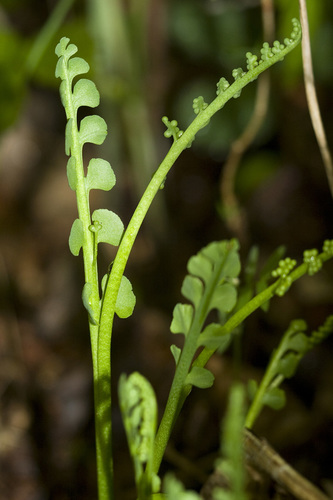
Botrychium minganense Vict. is a small fern that grows from an underground caudex, with only one thin leaf emerging above ground. The above-ground portion of this fern reaches between 8 and 25 centimeters tall total, while the single leaf grows up to 10 centimeters tall. The leaf is always divided into two distinct parts: a sterile photosynthetic part called the trophophore, and a fertile spore-bearing part called the sporophore. The sterile trophophore is a yellowish-green, clearly stalked blade that holds up to ten pairs of pinnae, also called leaflets. These leaflets are fan-shaped or spoon-shaped with entire or shallowly lobed margins, and are similar in size and evenly spaced along the central rachis. The fertile sporophore has a very different shape, bearing grape-like clusters of sporangia for reproduction; when spores are released, the sporophore is the same size or larger than the sterile blade. This species can easily be mistaken for three related moonwort species: Botrychium neolunaria (New World moonwort), Botrychium pallidum (pale moonwort), and Botrychium spathulatum (spatulate moonwort). Its spore release period falls between July and September, and it grows at elevations ranging from 1590 to 3290 meters, or 5215 to 10795 feet. This species has a global conservation rank of G5, and it occurs in small numbers across Canada and the United States; it was once recorded in Iceland. Its regional conservation status varies across its range: it is secure in British Columbia, apparently secure in Alberta, the Northwest Territories, Ontario, Quebec, Montana, and Washington State, vulnerable in Newfoundland, Nunavut, California, Colorado, Idaho, Minnesota, Oregon, and Wyoming, imperiled in Manitoba, New Brunswick, Nevada, and Wisconsin, and critically imperiled in Labrador, Saskatchewan, Arizona, New York, North Dakota, and Utah. It is possibly extirpated in Nova Scotia and Vermont. It occupies a wide range of habitat conditions from sunny to densely shaded, and from dry to permanently saturated. Documented habitats include meadows, prairies, woods, sand dunes, riverbanks, mesic hardwood forests, upland cedar forest, aspen-fir forest, wet mossy waterfall ledges, old forest openings, trails, fens, and seeps. It is often found associated with other Botrychium species, as well as Acer saccharum (sugar maple), Tilia americana (basswood), Uvularia grandiflora (large-flowered bellwort), and Aralia nudicaulis (wild sarsaparilla). In Minnesota, it is most frequently encountered in mesic hardwood forests.