About Botrychium lunaria (L.) Sw.
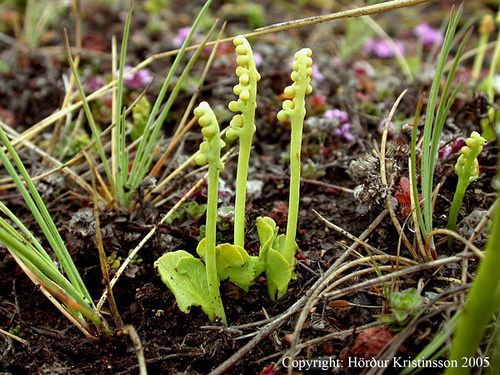
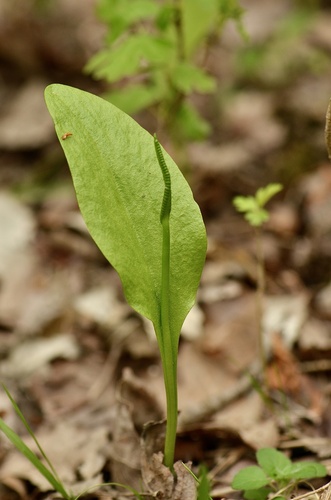
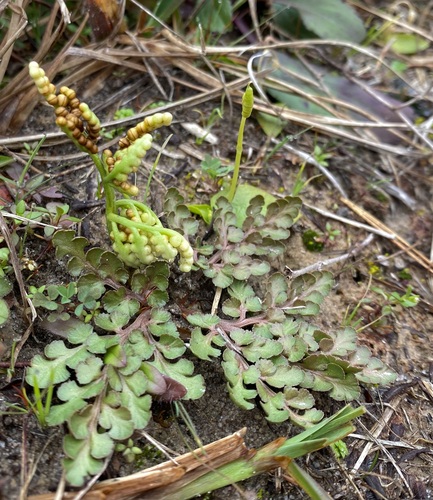
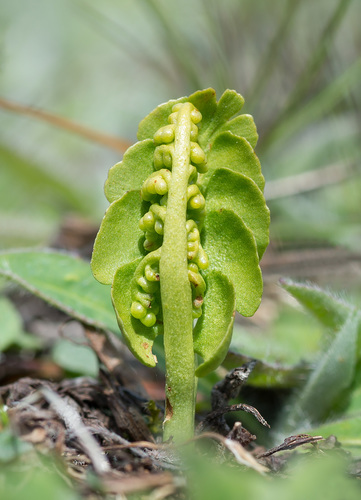
Botrychium lunaria (L.) Sw., commonly called moonwort, is a small fern that grows up to 30 cm (12 in) tall from an underground caudex. Its leaf is pinnate and divided into two distinct parts: a sterile frond and a fertile frond. The sterile frond holds 4 to 9 pairs of fan-shaped leaflets called pinnae. The fertile section of the leaf has a very different shape, bearing grape-like clusters of round sporangia that produce spores for reproduction. Like other members of the family Ophioglossaceae, this species is eusporangiate: its sporangia develop from more than one initial cell, and their sporangial walls are more than one cell thick. Its spores grow into underground, mycotrophic gametophytes. Moonworts die back at the end of summer, and often lie dormant for multiple seasons before reappearing above ground. This species has a circumpolar distribution, with confirmed records across Eurasia, North America, and Greenland. It also grows in northern Africa, the Himalayas, and the temperate zones of Australia, Tasmania, New Zealand, and South America. While its overall distribution is patchy and it may be rare in local areas, it is classified as Least Concern on the IUCN Red List of threatened species. There is documented evidence of population decline in the British Isles. In Ukraine, 189 total local populations (loci) have been recorded: 118 before 1980, 71 total after 1980, including 13 recorded only after 1980. In Britain, it occurs mainly in the north and west; in the lowlands of England, it has been largely extirpated, and its decline continues. For example, it was previously recorded at seven sites in Worcestershire, but now appears to be limited to just one site. Botrychium lunaria grows in relatively dry to moist short grassland, meadows, small woods, heaths, and moors, most often on higher ground. It rarely grows in full deciduous or pine forests, or open woodland. It has also been recorded growing on dune slacks. In Europe, the common moonwort is a characteristic species of four habitat types: acid Alpine and sub-Alpine grassland, southern Balkan montane grasslands, closed sand steppes in central Europe, and grasslands in Finland and Scandinavia. It will also colonize brownfield sites such as spoil heaps and shale banks, and this occurrence is especially notable in central Scotland. It prefers neutral to alkaline soils, often growing over limestone or chalk, or in other lime-rich habitats. It can be found at elevations up to 2,500 metres (8,200 ft). Both young and mature individuals rely on mycorrhizal relationships, which makes the species vulnerable to soil disturbance. Rotting plant material may be required for this fern to grow successfully. In Finland, the species is negatively impacted by modern agriculture, loss of rough pastures, and eutrophication of glades and dry meadows, and is classified as near threatened there.