About Bothus ocellatus (Agassiz, 1831)
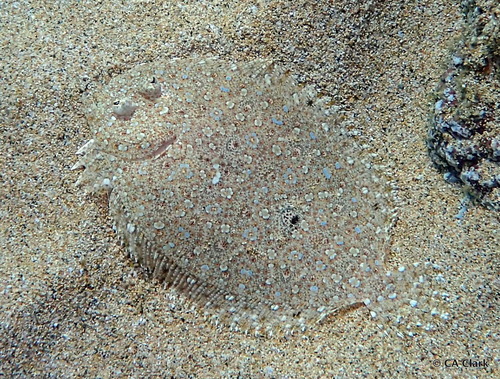
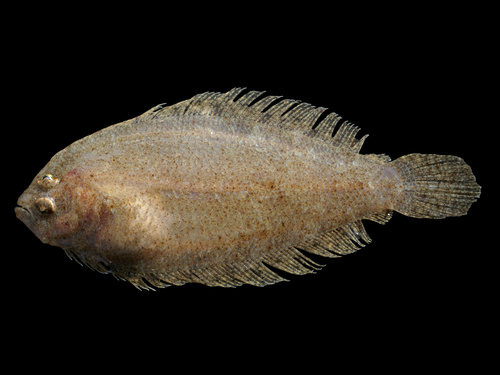
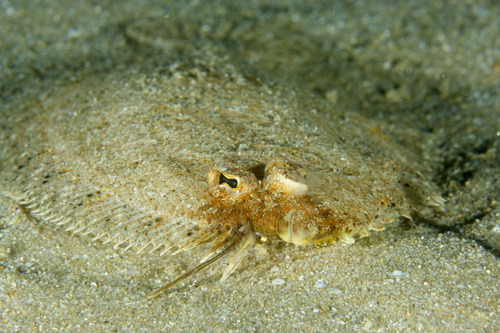
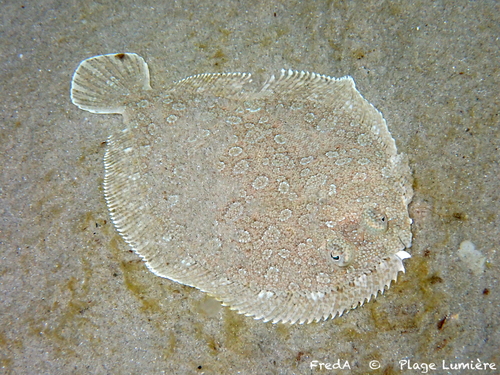
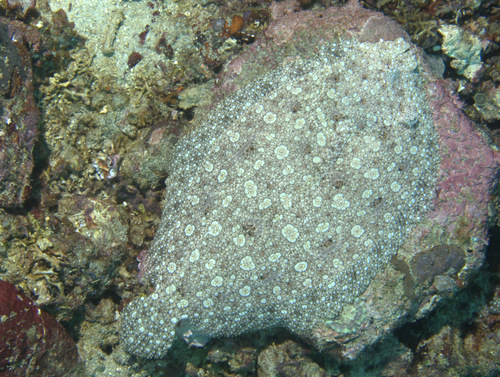
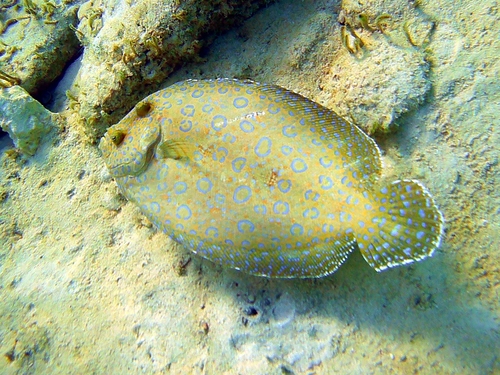
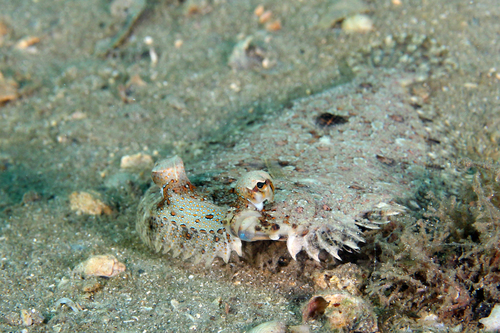
The eyed flounder (Bothus ocellatus) is a flattened, disc-shaped flatfish that reaches a maximum length of 18 cm (7 in), with a more common typical size of 12 cm (5 in). Like other members of its family, it rests on its right side, and its right eye migrates to the left side of its head during development. It has a large, protractile mouth; males have a spine on the snout and a bony bump in front of the lower eye. Its eyes are large and prominent, with the lower eye positioned slightly closer to the snout than the upper eye. A fleshy ridge runs above and behind both eyes. The dorsal fin, which has 76 to 91 soft rays, originates close to the upper eye, is long and ribbon-like, and is separated from the caudal fin by a gap. The anal fin has 58 to 69 soft rays, is also long, and is separate from the caudal fin. The body color is pale tan, grey, or brown, with patches, mottling, and ring-shaped markings. This species can change its body color to match its surrounding background, doing so in between two and eight seconds. Three larger dark spots sit along the straight section of the lateral line, and two fainter spots are present on the tail. It can be distinguished from the closely related twospot flounder (Bothus robinsi), which is slightly darker: in the eyed flounder, the two tail spots are positioned one above the other, while in the twospot flounder they are positioned one behind the other. The underside of the eyed flounder is pale. In terms of distribution and habitat, the eyed flounder occurs in the western Atlantic Ocean, Caribbean Sea, and Gulf of Mexico, with a range stretching from Canada down to southern Brazil. Its typical habitat is sandy flats near patch reefs, and it is often found close to areas of coral rubble and seagrass meadows. It most commonly occurs at depths down to around 50 m (164 ft), but has been recorded at greater depths of up to 110 m (361 ft). It spends most of its time resting on the seabed, and is sometimes semi-immersed in the seabed sediment.