About Bothus lunatus (Linnaeus, 1758)
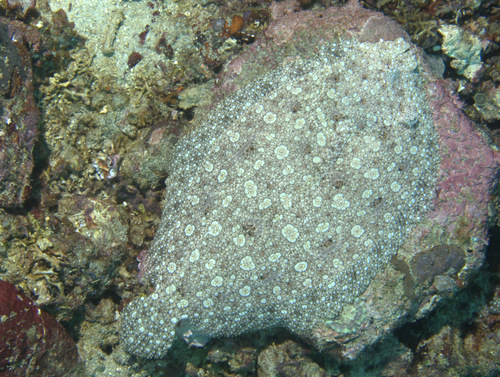
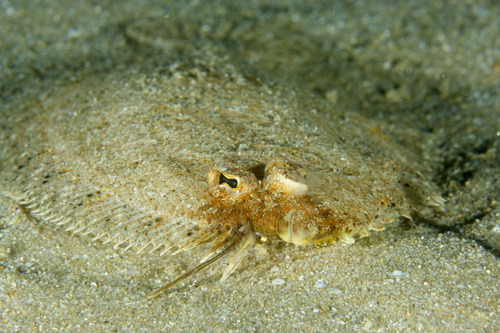
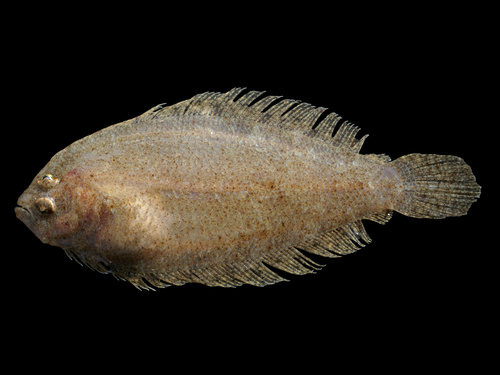
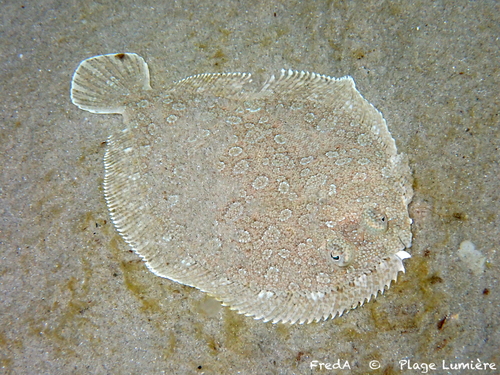
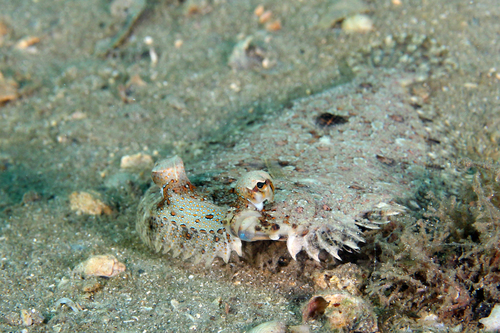
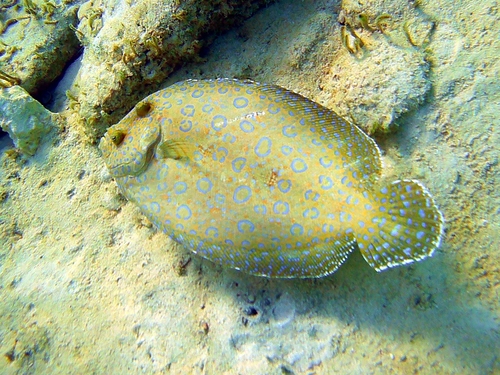
Bothus lunatus has a laterally flattened body, and orients itself with its right side facing downward and left side facing upward. Both eyes sit on this upper left surface, and project outward on short, thick stalks. Its body has a rounded shape, and the dorsal and anal fins nearly completely surround its body. The dorsal fin has 92 to 99 soft rays, while the anal fin has 71 to 76. The pectoral fins are long and often held erect. The average adult length is around 35 cm (14 in), with a maximum recorded length of 46 cm (18 in).
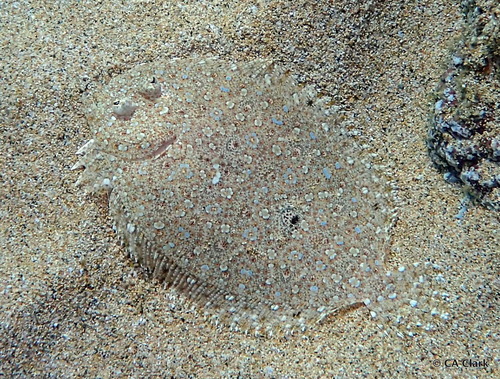
The upper surface of this flounder ranges in shade between grey, brown, and tan, and is marked with small blue spots and circular blue markings; the head and fins are also spotted and speckled with blue. There are two or three rather diffuse dark patches along the lateral line. This fish can alter its body coloration to closely match its surroundings, camouflaging itself when it rests on the seabed. Fish in the Bothus genus can change their coloration within two to eight seconds.
Bothus lunatus occurs in tropical and subtropical regions of the Atlantic Ocean and Caribbean Sea. Its range extends from Florida, the Bahamas, and Bermuda down to Brazil, but it is not found in the Gulf of Mexico. It is also present at the Gulf of Guinea and Ascension Island. It is typically found at depths between 1 and 20 m (3.3 and 65.6 ft), but can occur as deep as 100 m (328 ft). Its typical habitat consists of sandy areas near coral reefs, in seagrass meadows, or near mangroves. It is also sometimes found over rubble or hard substrates, and is one of the most common flounder species found near coral reefs.