About Bothrops taeniatus Wagler, 1824
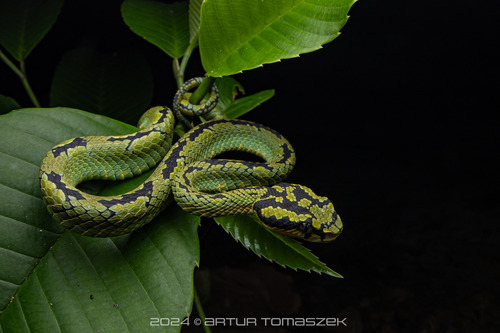
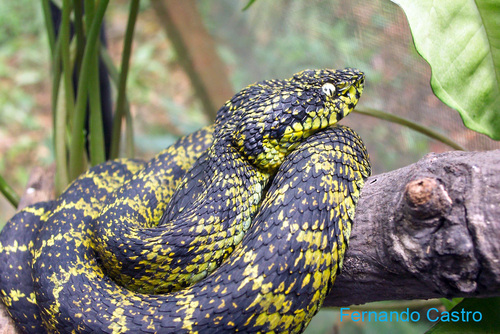
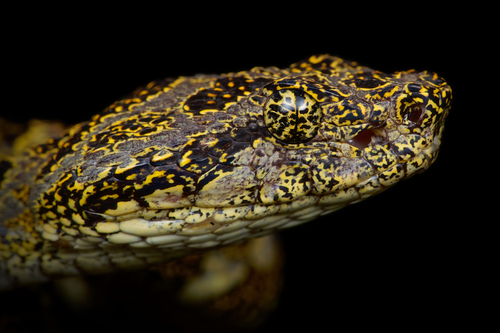
Adults of this species are typically no more than 100 cm (39 in) in total length, though some individuals can reach up to 150 cm (59 in). The largest recorded specimen, collected from Tepoe, Suriname, has a maximum total length of 175 cm (69 in). The body is relatively slender, and the species has a prehensile tail. Its overall color pattern is very complex, with base color ranging from lavender gray to yellow green, and juveniles go through significant ontogenetic color change as they mature into adults. It can be told apart from other species in its genus by two key traits: most of its subcaudal scales are single, and it has a row of distinct bold white spots along the junction where its dorsal and ventral scales meet. This species is widespread across the equatorial forests of South America, occurring in Ecuador, Colombia, Venezuela, Guyana, Suriname, French Guiana, Brazil, Peru, and Bolivia. The given type locality is "flumen Amazonum"; according to Vanzolini (1981), this refers to the stretch of the Amazon River between the mouth of the Tajapuru river (01°02'S, 51°02'W) and the mouth of the Negros river (03°08'S, 59°55'W). As an arboreal snake, it lives in lowland and foothill rainforests, as well as moist tropical forests. It is most commonly found among vines and low vegetation in primary forests and along forest edges, and it is suspected to primarily occupy the forest canopy.