About Bothrops punctatus (Garcia, 1896)
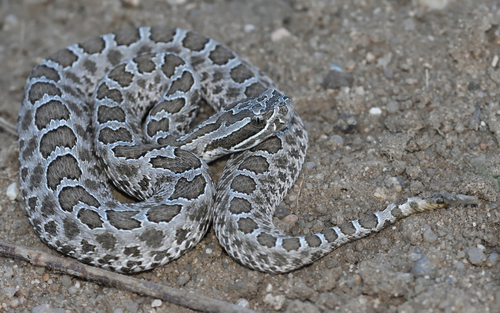
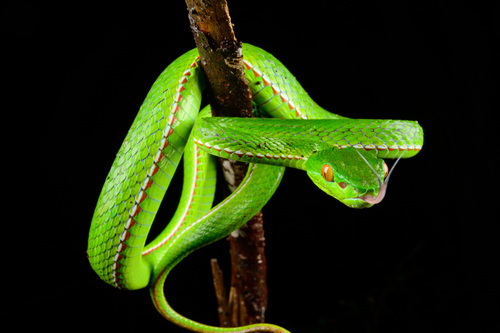
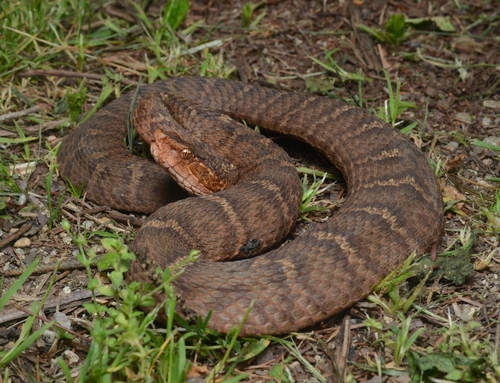
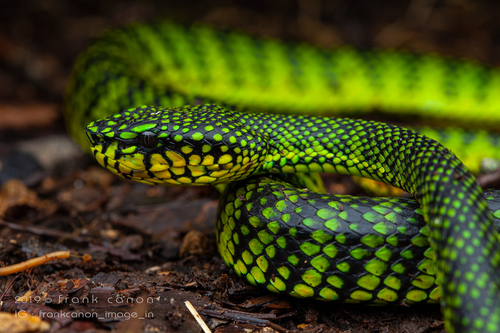
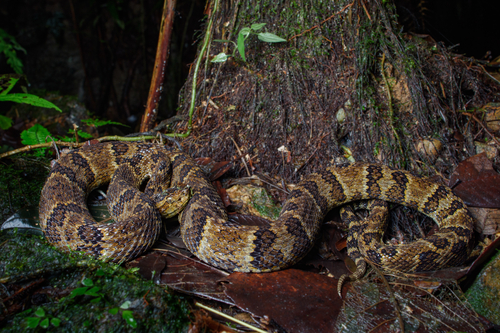
Adults of Bothrops punctatus commonly grow to over 100 cm in total length, and may exceed 150 cm. Its body shape and long tail indicate a semiarboreal lifestyle. The head is long and lance-shaped, and the species has exceptionally long fangs. Its scalation pattern follows this arrangement: 25 to 29 rows of dorsal scales; 186 to 211 ventral scales in males and 191 to 213 in females; 70 to 95 paired subcaudal scales in males and 80 to 90 paired subcaudal scales in females. The tail ends in a long, rounded spine that may curve slightly upward at the tip. On the head, there are 6 to 9 intersupraocular scales, 7 to 9 supralabial scales (with the second supralabial in contact with the prelacunal), and 11 to 12 sublabial scales. The species' color pattern features a pale brown to greenish tan base color, overlaid with 16 to 22 pairs of darker brown paravertebral blotches that have pale edges. Some of these paravertebral blotches merge along the dorsal midline. A row of lateral blotches is offset from the paravertebral blotches, creating a semi-banded appearance. Below this lateral row is a third series of dark blotches, alternating with lighter spots, that extends down onto the ventral scales. The belly is cream to pale tan with brown spots. A dark brown cheek stripe is present; this stripe is darkest along its outer edges, where it is narrowly bordered by a lighter color that can sometimes be orange or yellow. This species' geographic range extends from the Darién region of Panama, primarily through Chocó Department, along the Pacific slope of Colombia and Ecuador, to extreme northern Peru. Its given type locality is "Las Montañas del Dagua", Colombia. It inhabits tropical moist forest, tropical wet forest, subtropical moist forest, subtropical wet forest, and montane wet forest.