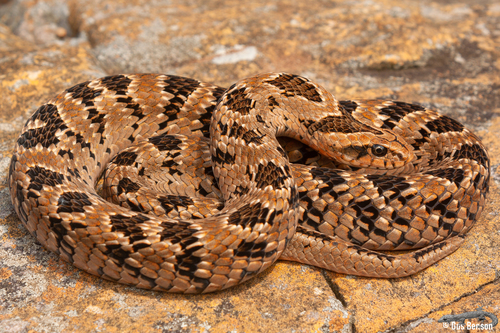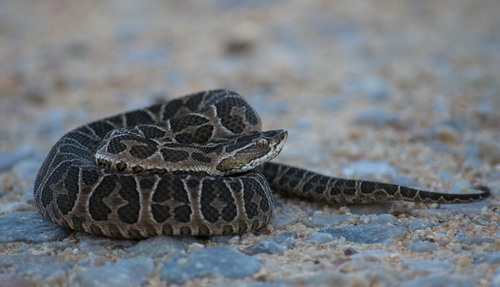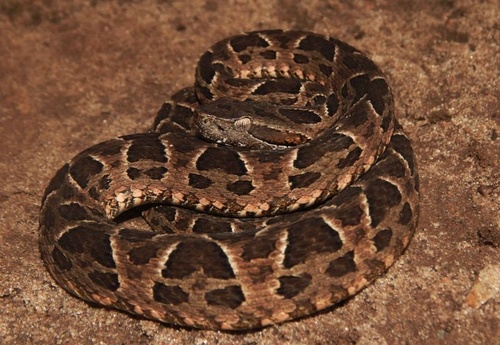
About Bothrops neuwiedi Wagler, 1824
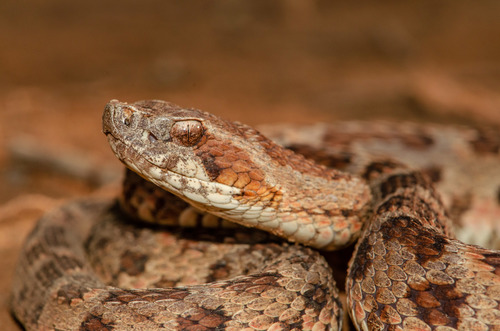
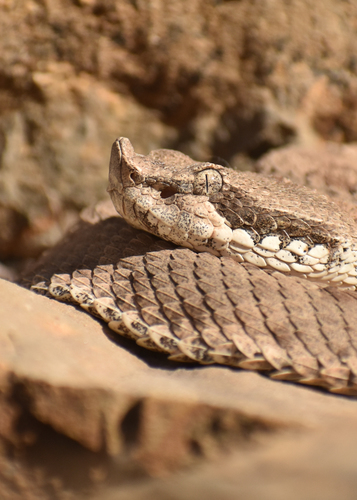
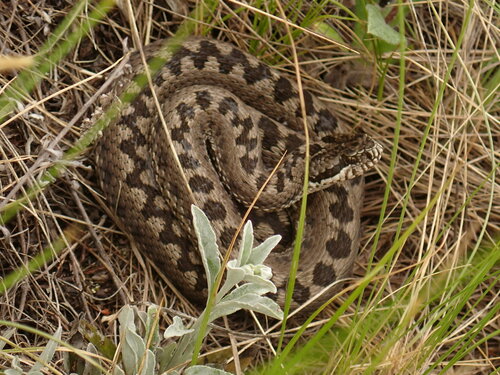
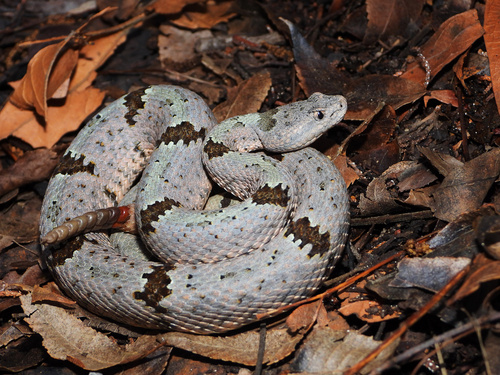
Adults of Bothrops neuwiedi average 60–70 centimetres (23+1⁄2–27+1⁄2 in) in total length, which includes the tail, but may reach a maximum total length of 100 cm (39+1⁄2 in). For head scalation: this species has 7–11 keeled intrasupraoculars, rarely 12 or as few as five; 9–13 sublabials, most commonly 10–11; and 7 to 8 supralabials, rarely seven or 10. The second supralabial is not fused to the prelacunal, and is usually separated from it. Two rows of small scales typically separate the subocular and fourth supralabial scales. At midbody, the dorsal scales are arranged in 22–29 rows, most often 25–27, and these scales are strongly keeled. Ventral scales count 158–179 in males and 164–185 in females, while divided subcaudal scales number 39–56 in males and 34–51 in females. The species' color pattern has a brown or dark-brown base color, covered by a series of 16–27 dark brown or black dorsolateral blotches. These blotches have white edges, may be trapezoidal, triangular, subtriangular, or headphone-shaped, and meet opposite each other at the middorsal line. The belly is white or yellow with gray speckling, and juveniles have a white tail tip. This species occurs in South America east of the Andes and south of approximately 5°S. Its range includes Brazil (southern Maranhão, Piauí, Ceará, Bahia, Goiás, Mato Grosso, an isolated population in Amazonas, Rondônia, and all southern Brazilian states), Bolivia, Paraguay, Argentina (Catamarca, Córdoba, Corrientes, Chaco, Entre Ríos, Formosa, Jujuy, La Pampa, La Rioja, Mendoza, Misiones, Salta, San Juan, San Luis, Santa Fe, Santiago del Estero and Tucumán) and Uruguay. According to Vanzolini (1981), the type locality is given as "provincia Bahiae" (Bahia province, Brazil). Bothrops neuwiedi lives in tropical and semitropical deciduous forest, temperate forest, and Atlantic Coast restingas, and is almost always associated with dry or semiarid rocky areas.