About Bothrops jararaca (Wied-Neuwied, 1824)
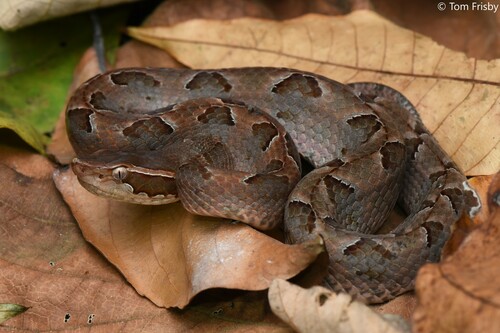
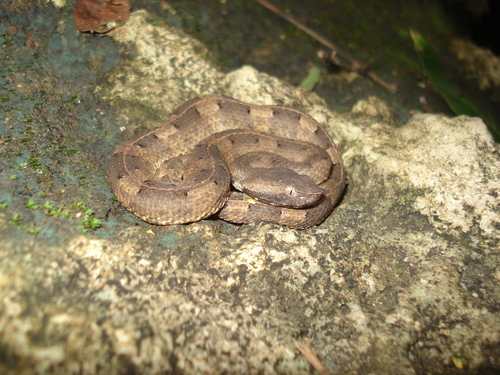
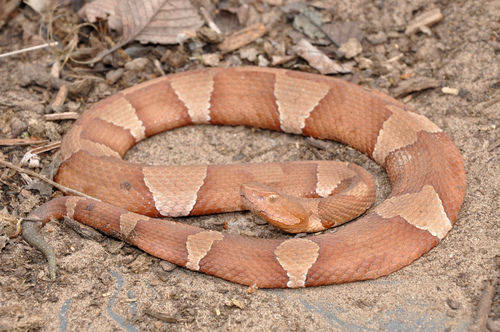
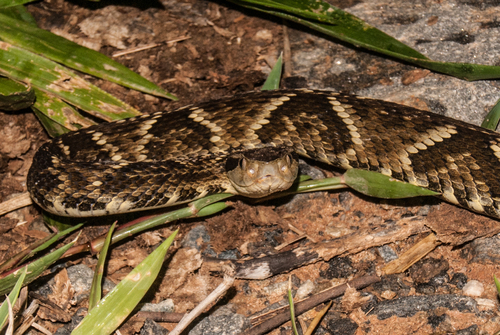
Bothrops jararaca (Wied-Neuwied, 1824) is a slender terrestrial viper species that reaches a maximum total length of 160 cm (63 in), with an average total length that is considerably shorter. Its head scalation features 5–12 weakly keeled intersupraocular scales, 7–9 supralabial scales (most often 8), where the second supralabial is fused with the prelacunal to form a lacunolabial structure, and 9–13 sublabial scales (most often 10–12). At midbody, it has 20–27 rows of dorsal scales, most commonly 23–25. It has 170–216 ventral scales (rarely 218), and 51–71 mostly paired subcaudal scales. Its color pattern is extremely variable: the dorsal ground color can be tan, brown, gray, yellow, olive, or almost maroon, and the midbody ground color is typically somewhat lighter than the ground color of the head, anterior body, and posterior body. Overlaid on the dorsal ground color is a series of pale-edged, dark brown subtriangular or trapezoidal markings along each side of the body; the apices of these markings reach the vertebral line. The markings may be positioned opposite one another, or partially or completely juxtaposed, with most individuals having a pattern that includes all three variations. Juvenile individuals have a white tail tip. On each side of the head, there is a prominent dark brown stripe that runs from behind the eye back to the angle of the mouth, usually touching the last three supralabials. This stripe is bordered dorsally by a distinct pale area. The tongue is black, and the iris ranges from gold to greenish gold, with slightly darker reticulations. This snake is native to southern Brazil, northeastern Paraguay, and Misiones Province in northern Argentina. The species' type locality was recorded as "Lagoa d'Arara am Mucurí" (Brazil) by Wied-Neuwied in 1825. Its elevational range extends from near sea level to over 1,000 m (3,280 ft). It primarily inhabits dense tropical perennial forests along the Atlantic coast up to around 1,000 m (3,280 ft) above sea level. It also occurs in thickets, savannas, semitropical highland forests, and cultivated fields. While adults are mainly terrestrial, juveniles are also arboreal. Mating occurs between April and May. Males mate with multiple females, and males fight with one another to access females. Females of this species undergo secondary vitellogenesis. Ovulation and fertilization take place in the spring, between October and December or January, and females give birth between February and April. On average, females produce 10 to 14 offspring per breeding season. Both sexes are thought to reach sexual maturity at two years of age. Angiotensin converting enzyme inhibitors (ACE inhibitors), a class of drugs used to treat hypertension and some forms of congestive heart failure, were developed from a peptide discovered in the venom of this species in 1965 by Brazilian scientist Sérgio Henrique Ferreira. A haemocoagulase enzyme derived from this species' venom is used as an antihemorrhagic drug.