About Bothrops bilineatus (Wied-Neuwied, 1821)
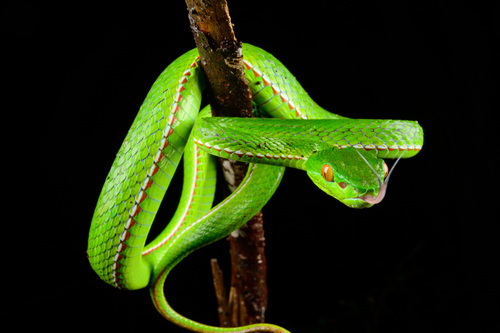
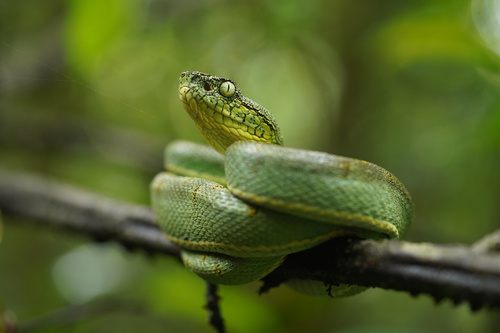
Adults of Bothrops bilineatus (Wied-Neuwied, 1821) usually do not exceed 70 cm (28 in) in total length, though some individuals may reach 100 cm (39 in). The maximum size recorded for this species is 123 cm (48 in). The body is relatively slender, and it has a prehensile tail. Its scalation features 23–35 dorsal scales at midbody, 190–218 ventral scales in males and 192–220 ventral scales in females, and 65–76 mostly divided subcaudal scales in males and 55–73 mostly divided subcaudal scales in females. On the head, there are 5–9 keeled intersupraocular scales, 8–12 sublabial scales, and 7–9 supralabial scales. For the supralabial scales, the second one is usually fused with the prelacunal scale to form a lacunolabial structure, though partial or complete sutures may be present to separate these two scales. The species' color pattern has a pale green base color, with a dorsal overlay of either scattered black spots, or a series of usually paired tan or reddish brown spots. A creamy yellow line runs along the full length of the body, bordering the ventral scales, while the belly itself is yellow with a faint green tinge along its border. The distal part of the tail is pink with a yellow border. The head is either green with scattered small black spots, or green with isolated tan or reddish brown spots that are outlined in black. The iris is pale green, and the labial scales are yellow green, often marked with black spots. The nominate subspecies, B. b. bilineata, has vertical dark stripes on its supralabial scales and a dorsal pattern of reddish brown spots marked with black flecks. This species occurs in the Amazon region of South America, including Colombia, Venezuela, Guyana, Suriname, French Guiana, Brazil, Ecuador, Peru, and Bolivia. An isolated population occurs on the Atlantic versant of southeastern Brazil. The given type locality is "Brasilien". It inhabits lowland rain forest, where it can be found in shrubbery, palms, and trees, and occurs in any area near water. It is almost always found in bushes and trees along streams, or along the edges of forest clearings. It is mostly associated with primary forest, but has also been recorded in older secondary forest located near primary forest. This species is ovoviviparous, meaning females give birth to live young.