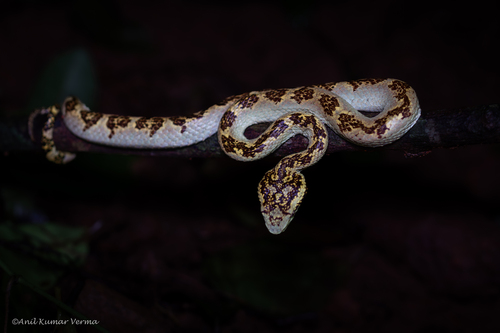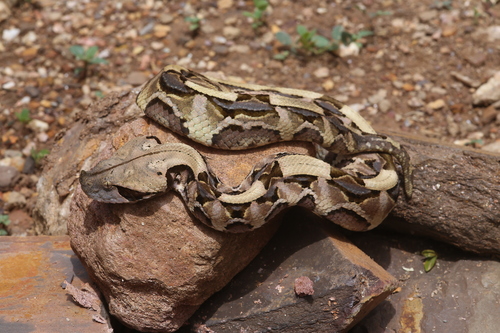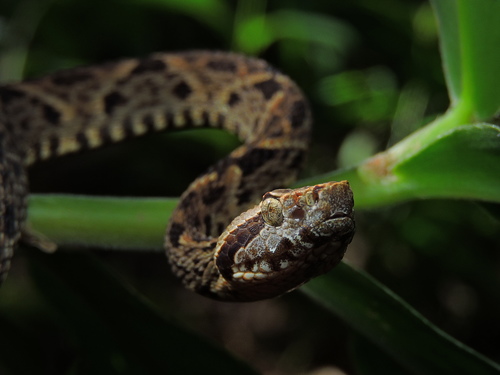
About Bothrops atrox (Linnaeus, 1758)
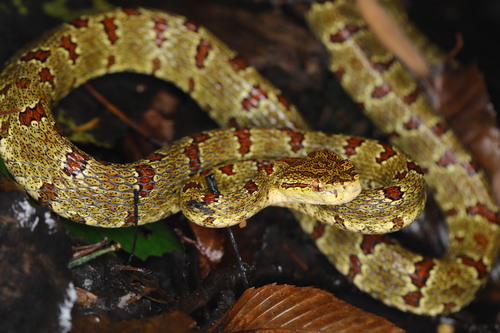
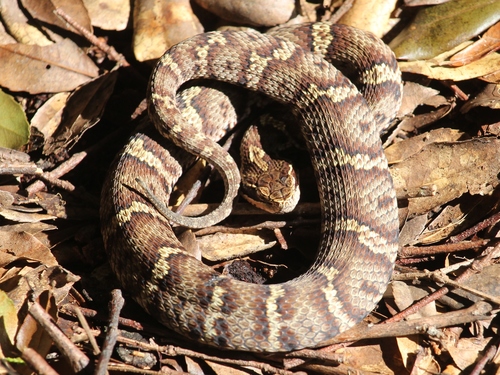
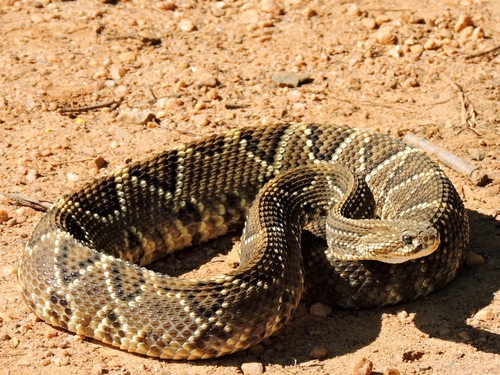
This is a terrestrial pit viper species. Adults usually reach a total length of 75–125 cm (about 30–50 inches) and have a moderately heavy body. Maximum size reports are unclear because this species is often confused with Bothrops asper. Soini (1974) recorded that the largest specimen among a series of 80 collected in northeastern Peru was a female measuring 138.8 cm (4 ft 6.6 in). The largest specimen measured by Campbell and Lamar (2004) was a female with a total length of 162 cm (5 ft 4 in). Scalation details are as follows: 23–29 (usually 23–25) rows of dorsal scales at midbody; 169–214 ventral scales in males and 177–214 ventral scales in females; 52–86 (usually 75 or fewer) usually divided subcaudal scales in males, and 47–72 subcaudal scales in females. On the head, the rostral scale is about as high as it is wide, or slightly higher than it is wide. There are 3–11 (usually 5–9) keeled intersupraocular scales, 7–13 (usually 8–11) sublabial scales, and 6–9 (usually seven) supralabial scales; the second supralabial scale is fused with the prelacunal to form a lacunolabial. The species' color pattern is highly variable. Ground color may be olive, brown, tan, gray, yellow, or rarely rusty. Body markings and their level of contrast are also highly variable: some specimens have very well-defined patterns, while others have almost no visible pattern. In general, the body pattern consists of a series of dorsolateral rectangular or trapezoidal blotches that extend from the first scale row to the middle of the back. These blotches may oppose or alternate across the midline, and often fuse to form bands. The blotches have pale borders that can be prominent in some cases, and may be invaded from below by tan or gray pigment, which occasionally divides them into pairs of ventrolateral spots. The belly may be white, cream, or yellowish gray, with increasing gray to black mottling toward the posterior end that fades again under the tail. The head usually has no markings other than a moderately wide postocular stripe that runs from behind the eye back to the angle of the mouth. The irises are gold or bronze with varying amounts of black reticulation, and the tongue is black. This species occurs in the tropical lowlands of South America east of the Andes, including southeastern Colombia, southern and eastern Venezuela, the island of Trinidad, Guyana, Suriname, French Guiana, eastern Ecuador, eastern Peru, Panama, northern Bolivia, and the northern half of Brazil. There is some taxonomic confusion regarding the status of the Trinidad population. The originally listed type locality is "Asia", which is clearly an error. Schmidt and Walker (1943:295) proposed correcting the type locality to "Surinam". Along with Bothrops caribbaeus and B. lanceolatus, it is one of three Bothrops species found in the West Indies. In Trinidad, it prefers wet forests from sea level up to 940 m (3,080 ft). Despite widespread rain forest destruction, it is one of the most numerous and common pit vipers and is not endangered. Bothrops atrox gives birth to live young, and can produce up to 80 offspring in a single litter. Adults breed year-round. After mating, females carrying developing embryos move between sunlit and shaded areas to maintain a constant temperature for themselves and their embryos. In equatorial regions, the gestation period is about three to four months, and the average litter size is 60 young. Newborns are about 30 cm (12 in) in total length, more brightly colored than adults, and have yellow or beige tails. Three species in the Neotropical Bothrops atrox group have been confirmed to undergo facultative parthenogenesis, based on captive observations and analysis using molecular markers (heterologous microsatellites). In these confirmed cases, infertile eggs, non-viable ova, and malformed offspring were frequent occurrences.