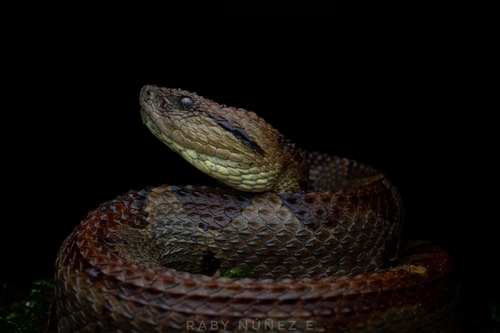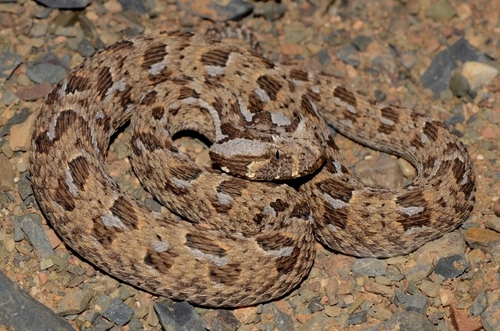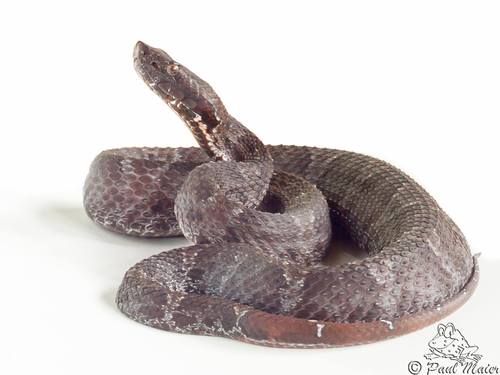
About Bothrocophias campbelli (Freire-Lascano, 1991)
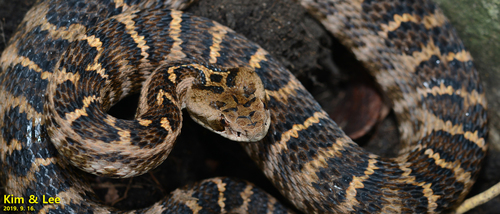
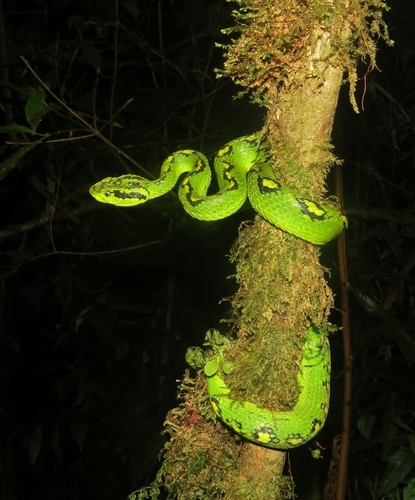
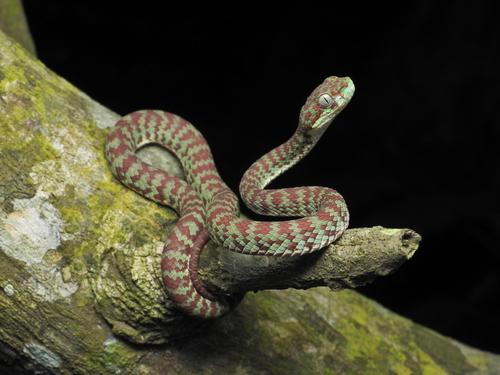
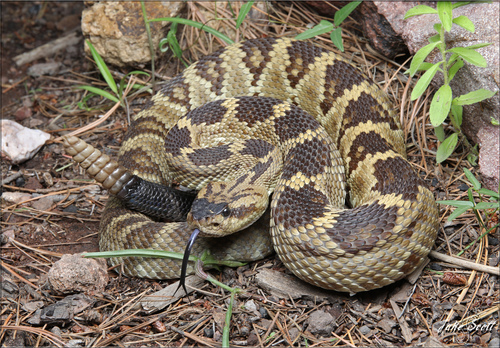
This section describes the physical characteristics, geographic range, habitat, and reproductive mode of Bothrocophias campbelli. The total length of all currently available specimens of B. campbelli ranges as follows: the type specimen, an adult male, measures 87.0 cm (34+1⁄4 in); a large gravid female measures 105.7 cm (41+5⁄8 in); one specimen from Imbabura, Ecuador measures 121.9 cm (48.0 in); and another specimen from the type locality measures 123.0 cm (48+3⁄8 in). For scalation, B. campbelli has 21 to 25 (most often 23) rows of dorsal scales at midbody. All dorsal scales are keeled, except for the first rows. The posterior dorsal scales have tubercular keels, a trait that appears even in small specimens; in large specimens, these keels become highly elevated. Males have 152 to 167 ventral scales, while females have 159 to 177 ventral scales. Males have 51 to 64 paired subcaudal scales, while females have 48 to 60 paired subcaudal scales. On the head, there are 3 to 8 intersupraocular scales, 7 to 8 supralabial scales (the second supralabial is usually fused with the prelacunal to form a lacunolabial), and 9 to 10 (most often 9) sublabial scales. B. campbelli occurs in the Pacific lowlands and slopes from west-central Colombia to Ecuador. Its given type locality is "Recinto Huagal-Sacramento, cantón Pallatanga, Provincia de Chimborazo, Ecuador. 1500–2000 mts. de altura [4,900–6,600 feet]". The preferred natural habitat of B. campbelli is forest, at altitudes between 800 and 2,000 m (2,600–6,600 ft). B. campbelli reproduces via viviparity.